


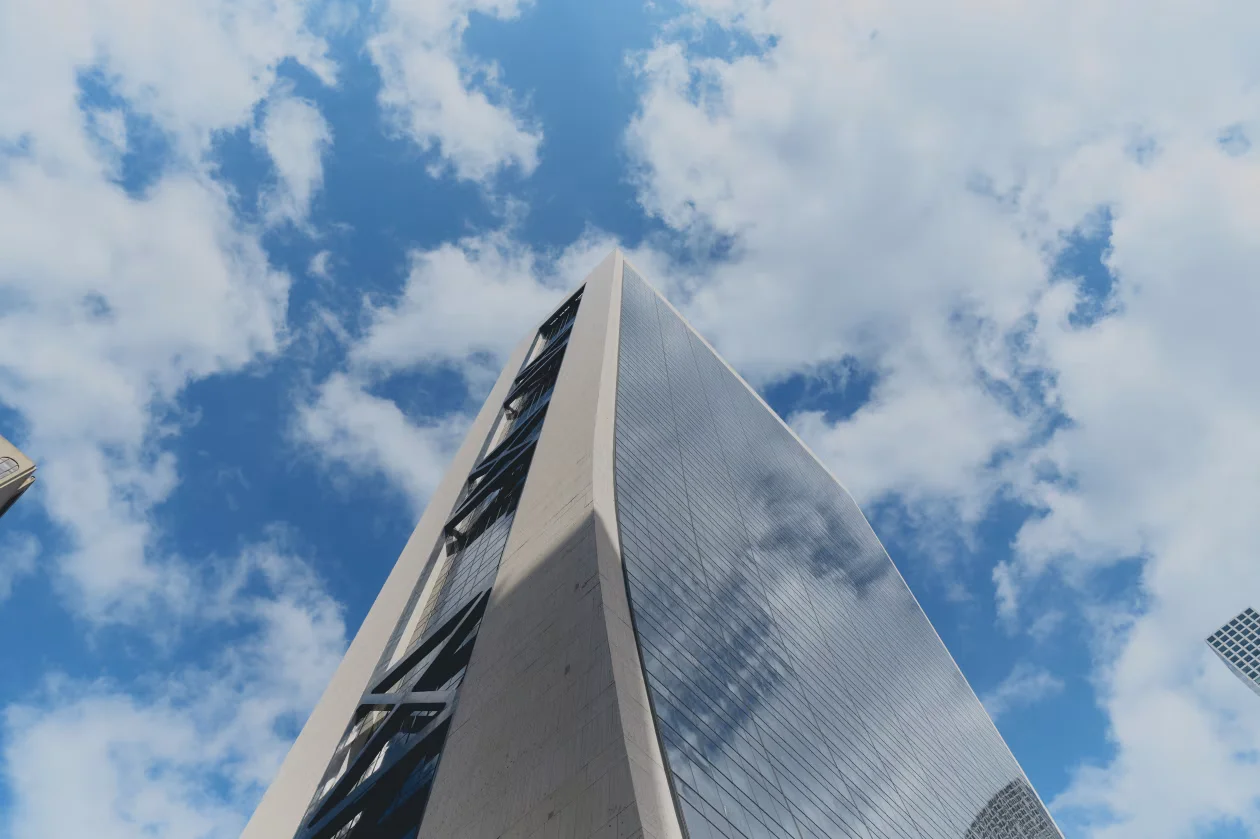
A Midtown Manhattan office tower once challenged by elevated vacancy has emerged as one of New York City’s most closely watched leasing success stories after securing a record-setting rent for space in the Nine West building, highlighting how premium amenities, curated design features, and repositioning strategies are reshaping demand in a still-fragile U.S. office market. The property’s transformation—supported by museum-quality artwork and a planned restaurant from Catch Hospitality Group—illustrates how landlords are competing for tenants as hybrid work continues to reshape corporate real estate decisions.
Located in Manhattan’s Plaza District, the Nine West building had previously struggled with elevated vacancy following tenant departures during the pandemic-era office reset. But recent leasing activity, including a high-profile agreement at one of the highest rents recorded for the property, signals renewed interest in upgraded “experience-focused” office environments. Analysts say such repositioning strategies are increasingly critical as companies consolidate footprints into fewer but higher-quality locations.
Office landlords across New York City have faced persistent pressure since 2020, when remote and hybrid work policies reduced space utilization across major financial and professional services firms. According to Federal Reserve regional economic commentary and commercial brokerage trend reports, Class A office properties with strong transit access and upgraded amenities have generally recovered faster than commodity office buildings lacking tenant-focused upgrades.
The Nine West tower’s strategy reflects that broader shift. By introducing curated artwork from internationally recognized artists such as Pablo Picasso and Henri Matisse and integrating hospitality-oriented tenant amenities—including a planned Catch Hospitality restaurant—the building’s ownership repositioned the property as a destination workplace rather than a traditional office asset. Economists note that experiential features increasingly influence corporate leasing decisions in major gateway markets like New York.
Macro conditions continue to shape how quickly office leasing rebounds nationwide. Higher borrowing costs following Federal Reserve rate increases between 2022 and 2024 raised refinancing risks for many office owners and slowed redevelopment timelines. According to Federal Reserve Economic Data (FRED) indicators, elevated interest rates tend to reduce commercial transaction volumes and delay repositioning investments unless properties demonstrate strong leasing momentum.
Inflation has also played a role in landlord strategy. Bureau of Labor Statistics data shows that construction inputs and labor costs remain above pre-pandemic levels, making large-scale renovations more expensive. In response, many office owners—including those behind Nine West—have focused on targeted amenity upgrades rather than full structural redevelopment to attract tenants while controlling capital expenditures.
Economic activity in gateway office markets remains uneven, however. Analysts say employment growth in finance, technology, and professional services sectors—traditionally the largest users of Manhattan office space—continues to influence leasing velocity more than any single building-level improvement.
From a real estate investment perspective, Nine West’s leasing momentum could influence how institutional capital evaluates repositioned office properties nationwide. Investors increasingly distinguish between commodity office assets and “amenitized trophy-lite” buildings capable of commanding premium rents even during periods of reduced office demand. In many markets, upgraded Class A properties have outperformed older inventory in both occupancy stability and lease renewal rates.
Developers and landlords across Florida and other Sun Belt markets are watching closely. Although office utilization patterns differ from New York’s dense urban core, similar amenity-driven repositioning strategies have appeared in Miami, Tampa, and Orlando. Industry observers note that flexible layouts, hospitality-style common areas, and mixed-use integrations are increasingly common tools used to maintain leasing competitiveness.
Homebuyers may also see indirect impacts from high-profile office repositioning successes like Nine West’s. Historically, strong leasing performance in major employment centers supports surrounding housing demand by reinforcing job concentration in urban cores. According to National Association of Realtors housing trend analyses, proximity to stable employment hubs often contributes to long-term residential price resilience in nearby neighborhoods.
For investors evaluating mixed-use or transit-oriented development opportunities, office stabilization in gateway markets can influence capital allocation strategies nationwide. When institutional confidence returns to premium office assets, it often supports broader urban redevelopment pipelines that include residential and retail components.
Mortgage conditions remain a key variable shaping how quickly office-market improvements translate into housing activity. Freddie Mac data shows mortgage rates have fluctuated near the mid-6% range in recent months, and even a one-percentage-point shift in borrowing costs can change monthly payments by roughly $150 to $300 on a $300,000 loan depending on loan structure. That variability can influence whether households choose urban-adjacent housing markets tied to employment centers or more distant suburban alternatives.
Renters may also experience secondary effects if stabilized office corridors support additional retail and mixed-use construction nearby. Historically, improved employment stability in major business districts has been associated with stronger rental demand in adjacent neighborhoods, though outcomes vary widely depending on local supply pipelines.
Looking ahead, the Nine West tower’s leasing success may serve as a case study for office owners navigating the post-pandemic workplace transition. Analysts say properties that combine hospitality-driven amenities, curated design, and transit accessibility could continue attracting tenants even as hybrid work reshapes long-term demand for office space across U.S. cities.