




Author: Asim Iftikhar



BRRRR (Buy, Rehab, Rent, Refinance, Repeat) is one of the most talked-about real estate investing frameworks because it attempts to recycle capital: you buy at a discount, improve the property, stabilize it with a tenant, then refinance to (ideally) recover some or most of your invested cash and repeat. Florida’s baseline housing costs are not “cheap,” and that matters because BRRRR relies on a spread between all-in cost and stabilized value. Before you dive into strategies like BRRRR, it helps to understand key insights about the Florida market and when buying property in Florida and buyers Should know in 2026…
Poinciana (primarily ZIP codes 34759 and 34758) has long been on Central Florida investors’ radar because it often sits in a more affordable price band than many Orlando-area submarkets, while still benefiting from the broader Orlando–Kissimmee region’s household growth and rental demand. But in 2026, “Is it still a good investment area?” can’t be answered with a blanket yes/no. The right way to analyze Poinciana is to combine: Government baseline housing metrics (income, home values, owner costs, rent) Market pricing + liquidity indicators (home value indices, days to pending) Yield math, stress-tested for realistic expenses (HOA/insurance/maintenance/vacancy) This article provides a…

Kissimmee has been a high-attention market for years because it sits inside the broader Orlando–Kissimmee metro engine: tourism, logistics, service employment, and continued household formation across Central Florida. But when it comes to buying property in Kissimmee, asking whether it is still a good investment area in 2026 is not a simple yes-or-no question. In this market, outcomes vary dramatically by ZIP code, property type, HOA rules, insurance profile, and exit strategy. A compliant, investor-grade way to answer the question is to evaluate Kissimmee on three measurable pillars: Affordability and rent pressure (demand support) Liquidity (how quickly inventory converts into…
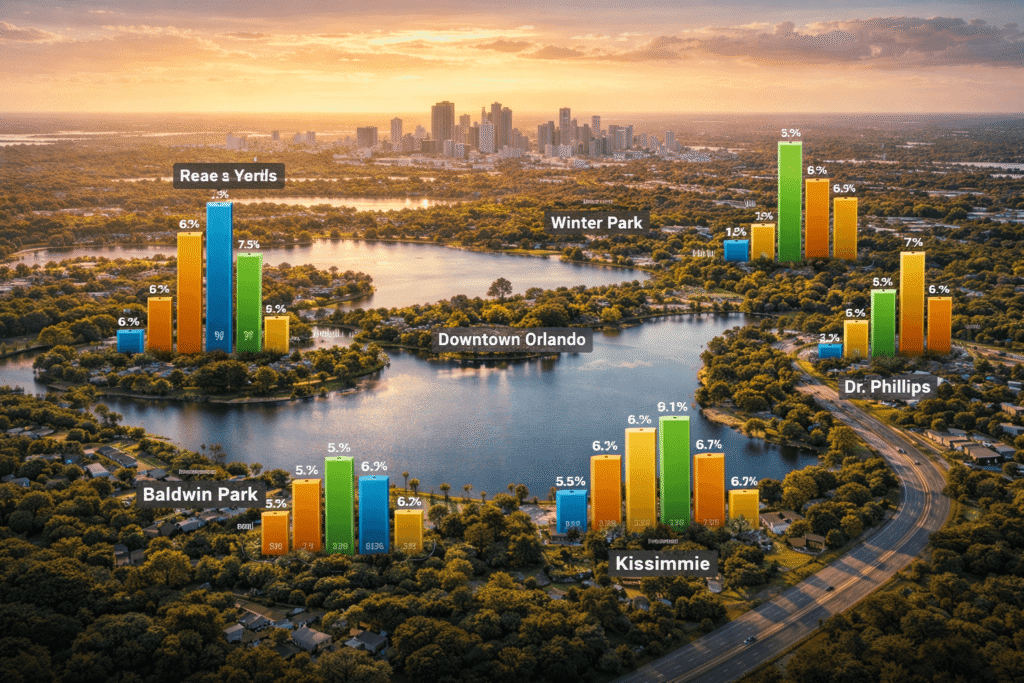
Investors exploring real estate properties in Orlando often ask a simple question: “Where are the best rental yields?” The honest answer is that Orlando doesn’t have one “average yield”—it has a yield spectrum driven by (1) purchase price levels, (2) rent levels, and (3) operating costs such as taxes, insurance, HOA fees, maintenance, vacancy, and property management. This report gives you a replicable, compliance-friendly way to estimate gross rental yield by neighborhood proxy (ZIP codes), then adds stress tests and scenario modeling so you can evaluate risk—without making promises, predictions, or individualized recommendations. Quick definitions Gross rental yield A common…

Orlando-area investors in 2026 are making decisions in a market that is still balancing affordability constraints with long-run demand drivers for property in Orlando, including jobs, in-migration, tourism, and household formation. The right way to approach “best ZIP codes” isn’t a hype list—it’s a repeatable screening model that compares ZIPs on measurable indicators like price level, liquidity, and rent affordability pressure, while staying honest about what ZIP codes can’t tell you, such as block-by-block variation, HOA risk, insurance volatility, and property condition. Government benchmarks are useful for context. For Orlando city, the Census Bureau’s ACS 2020–2024 QuickFacts shows a median…

HOA (Homeowners Association) fees can significantly influence the value of property in Orlando. These fees are typically paid monthly or quarterly and cover services such as landscaping, security, community amenities, exterior maintenance, and common area upkeep. In well-managed communities across Orlando, HOA fees often help maintain neighborhood standards, which can protect and even increase property values over time. For buyers, attractive amenities like gated entry, swimming pools, fitness centers, and well-maintained parks can make a property more desirable. This added appeal may lead to stronger resale value and higher demand. However, high HOA fees can also discourage some buyers, especially…
Earnest money is one of the most misunderstood parts of home buyers in Florida. Many home buyers hear “earnest money deposit” and assume it is the same as a down payment. It is not. Others assume it is automatically refundable. It depends. And some buyers do not realize that Florida has specific escrow-handling rules for licensed real estate brokers when a deposit becomes disputed. This Florida-focused, educational guide explains what earnest money is, why it exists, how it is commonly structured in Florida transactions, what influences the amount, how escrow handling generally works, and the most common scenarios where buyers…

Property buyers in Florida often hear two similar-sounding steps during the purchase process: the appraisal and the home inspection. home buyers in Florida can go through these steps around the same time, as both involve a third party visiting the property and can influence whether a deal moves forward. However, they exist for different reasons, measure different things, and serve different decision-makers. This Florida-focused educational guide explains what each one is, what it usually covers, how it connects to lending and negotiations, and why confusing the two can create expensive surprises. The goal is to clarify terminology and process not…

What Happens After Offer Acceptance for Home Buyers in Florida? Once a seller accepts an offer, home buyers in Florida move from “negotiation” to “execution.” This stage is where timelines, contingencies, inspections, lender underwriting, title work, and insurance requirements all converge. Many deals fall apart—or get delayed—after acceptance because property buyers in Florida and sometimes sellers underestimate how many steps must happen in a short window. This educational guide explains the common phases that typically occur after an offer is accepted in Florida, what each phase is meant to accomplish, and where delays most often happen. It is written as a…

Buying property in Florida is an exciting step for homebuyers and investors. However, one of the most common questions is how long the closing process actually takes. The timeline can vary depending on financing, inspections, negotiations, and lender requirements. On average, closing on a property in Florida can take anywhere from 30 to 60 days, but some transactions may close faster or take longer depending on circumstances. Understanding the Closing Process for Property in Florida Closing on a property in Florida is the final step in the real estate transaction. This is when ownership officially transfers from the seller to…