




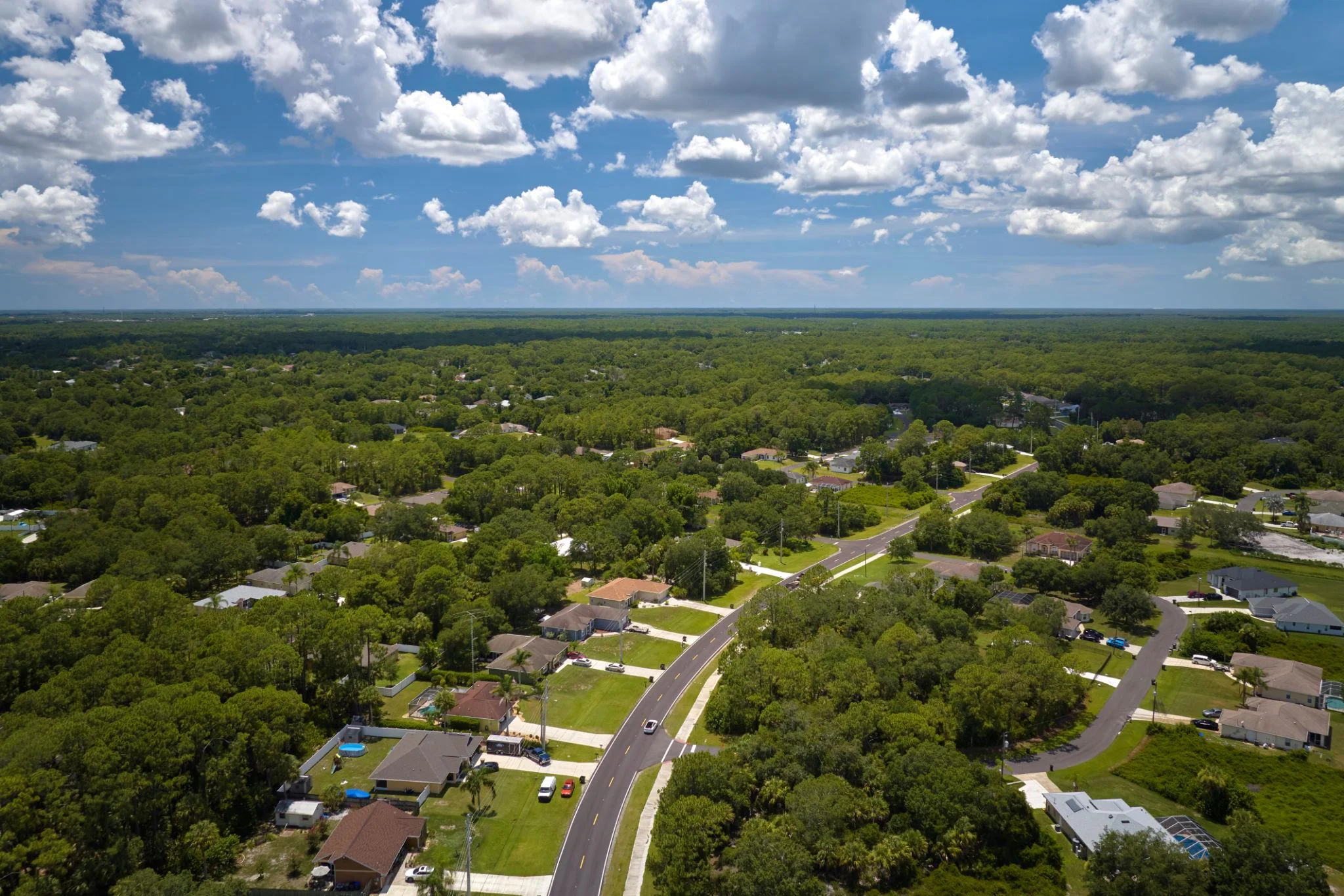
Three years ago, the story wrote itself: Florida was gaining more residents from domestic migration than any other state in America, pulling in more than 310,000 net new residents in 2022 alone as remote workers, retirees, and households fleeing high-tax states discovered the combination of sunshine, no state income tax, and what was then a relatively affordable housing market. By 2025, net domestic migration to Florida had fallen to just 22,517a 93% decline from the 2022 peak, according to U.S. Census Bureau population estimates. Florida dropped to the number eight position nationally in net domestic migration, trailing South Carolina, Idaho, North Carolina, Texas, Utah, and others.
The numbers require careful interpretation because they tell two separate stories simultaneously. Florida still received approximately 574,000 gross inbound movers from other states in 2024more than any other state, per Census ACS 2024 1-year data. It also exported its second-largest volume of outbound residents. The 93% collapse in net migration is not a story of Florida becoming unpopular with Americans. It is a story of Florida becoming less affordable for the Americans it used to retain and attract: younger workers, moderate-income families, and households for whom the housing cost and insurance environment of 2026 Florida is fundamentally different from the Florida they imagined.
This article reports on who is arriving and who is leaving, what the data says about why, and what the divergence between inbound and outbound populations means for Florida’s housing market, workforce, and communities. The reporting draws on U.S. Census Bureau migration data, IRS Statistics of Income migration tables, Florida Chamber Foundation migration research, Florida TaxWatch cost analysis, and direct professional observation from ACT Global Media’s licensed real estate team across Florida’s markets.
The Florida populations most directly affected: young workers in the 20-to-29 age range who are leaving at the highest rates, and the moderate-income renter households whose housing affordability is eroding faster than their wages are growing.
Key Findings From This Report
- Florida’s net domestic migration fell from 310,892 in 2022 to just 22,517 in 2025, a 93% decline over three years, per U.S. Census Bureau annual population estimates. The state fell from first nationally in net domestic migration to eighth place, now trailing South Carolina, Idaho, North Carolina, Texas, Utah, Tennessee, and Delaware.
- Florida led the nation in net international migration July 2024 through June 2025, receiving 178,674 more international arrivals than departures, per Census Bureau datamore than Texas (167,475), California (109,278), or New York (95,634). International migration is the primary population growth driver that has offset the domestic migration collapse.
- The Florida Chamber Foundation’s 2024 Florida Migration Trends Report documented that Florida had its largest outflow of residents ever in 2023, with approximately 511,000 departures from other states. Nearly 25% of the departures were by residents aged 20 to 29, with the median age of leavers at 32.4 years.
- Florida’s cost of living accelerated from approximately 1.3% annually in the prior decade to approximately 5.8% annually in recent years, a nearly fivefold increase, per Florida TaxWatch April 2026 analysis. Since Q1 2019, the median home listing price increased 41%, while per capita personal income increased only 35%, per Florida Chamber Foundation analysis citing Realtor.com and Bureau of Economic Analysis data.
- Who is moving in versus out has diverged dramatically by income and age. According to SmartAsset’s IRS data analysis, households moving from New York to Florida in recent years had average adjusted gross income of approximately $185,000. New Jersey households moving to Florida carried approximately $228,205 in average AGI. Florida’s top departure destination is Georgia, which received 26,876 Florida householdsthe largest single outbound flowfollowed by Tennessee and North Carolina: all states with lower median home prices than Florida.
- Florida’s GDP reached $1.72 trillion, ranking fourth among U.S. states, per Bureau of Economic Analysis Q2 2024 data. The state economy is strong. The affordability environment for workers who power that economy is not. The Florida Chamber Foundation has warned that employers face a critical talent shortage as young workers leave a state with more open positions than workers to fill them.
- South Carolina, which gained 66,622 net domestic migrants in the period July 2024-June 2025, achieved 1.5% population growth from domestic migration alonethe strongest rate in the nation, per Census Bureau data. Florida, North Carolina, Tennessee, and Texas are the primary competitors for the household types that Florida is now losing.
The Two Floridas: Who Is Arriving and Who Is Leaving
Florida’s migration story in 2026 cannot be understood as a single trend, because it is two distinct trends running simultaneously and pointing in opposite directions.
The arriving population skews older and wealthier. IRS Statistics of Income migration data analyzed by SmartAsset shows that households moving from New York to Florida carried average adjusted gross income of approximately $185,000. New Jersey households moving to Florida averaged $228,205 in AGI. California households moved in with $187,025 in average AGI. These are not median American households. They are households with the financial capacity to absorb Florida’s insurance costs, to purchase rather than rent, and to carry the total cost of Florida ownership that has expanded substantially since 2020. The New York-to-Florida pipeline produced 51,967 household moves in the study period, by far the largest single inbound corridor. These arrivals bring income and wealth that shows up in Florida’s strong net income migration figures: the Florida Chamber Foundation reported that Florida led the nation in net income migration with a $36.1 billion gain from 2021 to 2022, with the largest flows from New York, New Jersey, Illinois, California, and Pennsylvania.
The departing population skews younger and less wealthy. The Florida Chamber Foundation’s 2024 Migration Trends Report found that nearly 25% of Florida’s departures were residents aged 20 to 29, with a median departing age of 32.4 years. Compared to those moving in, those moving out had lower median incomes, slightly lower educational attainment, and lower homeownership rates. These are the characteristics of a younger workforce population, early in career formation, for whom Florida’s cost structure is incompatible with building financial stability.
The departure destinations are instructive. Floridians are not moving to other expensive metros. They are moving to Tennessee, North Carolina, and Georgiastates where median home listing prices are lower than Florida’s, where a similar wage buys more housing, and where the total cost of ownership does not include the insurance escalation Florida has experienced since 2022. The second-most common reason cited by departing Floridians aged 20 to 29 was job opportunities in other states, per Census Current Population Survey data. But the Florida Chamber Foundation noted that Florida actually has more open positions than workers to fill them. The “job opportunities elsewhere” framing may reflect not an absence of jobs in Florida but an absence of the specific well-compensated jobs, in tech, finance, and professional services, that would justify staying in a high-cost market. (Source: Florida Chamber Foundation, 2024 Florida Migration Trends Report)
Florida Migration Flows: Who Is Arriving and Who Is Leaving
| Population Segment | Direction | Primary Origins / Destinations | Avg. AGI / Income Profile | Primary Drivers |
| Wealthy retirees / pre-retirees | Arriving | New York, New Jersey, Illinois, California | $185,000$228,000 avg. AGI | No state income tax, climate, wealth transfer |
| High-income professionals | Arriving | New York, California, New Jersey | $150,000+ | Remote work flexibility, tax savings |
| International arrivals | Arriving | International (leading all states) | Variable | Economic opportunity, family networks |
| Young workers (20-29) | Leaving | Tennessee, North Carolina, Georgia | Below Florida median income | Housing affordability, career opportunity |
| Middle-income families | Leaving | Tennessee, North Carolina, Georgia | Middle-income households | Lower home prices, lower insurance, lower cost |
| Long-term moderate renters | Leaving or displaced | Varies | Below-median income | Rent escalation, inability to access homeownership |
Sources: SmartAsset/IRS Statistics of Income migration data; Florida Chamber Foundation 2024 Migration Trends Report; U.S. Census Bureau population estimates and ACS 2024 1-year data; U.S. Census Bureau Current Population Survey Annual Social and Economic Supplements 2023.
The table reveals a demographic sorting that is reshaping Florida’s population composition: older, wealthier, and more likely to be retired or near retirement households are arriving, while younger, working-age, and lower-income households are departing. Florida continues to grow in total population because international migration and births more than offset the domestic departure rate. But the demographic composition of that growth has specific implications for Florida’s housing market, its workforce, and its fiscal balance between workers contributing payroll and retirees drawing public services.
The Cost of Living Acceleration and What It Has Done to Florida’s Attractiveness
Florida’s affordability collapse did not happen in a single year. It happened in a sequence that is now visible in the migration data.
The pandemic migration boom of 2020-2022 was built on a genuine affordability advantage: Florida’s housing costs were substantially below the Northeast and California metros that were exporting residents. A household leaving New York City in 2021 and buying in Tampa Bay or Jacksonville was capturing a real, large financial benefit. That advantage has eroded substantially. Florida TaxWatch’s April 2026 analysis found that the state’s cost of living accelerated from approximately 1.3% annually in the prior decade to approximately 5.8% annually in recent years, a nearly fivefold increase. Housing costs led the acceleration.
The specific mechanism: the median home listing price in Florida increased 41% since Q1 2019, per Florida Chamber Foundation citing Realtor.com data, while per capita personal income increased only 35% over the same period. The 6-percentage-point gap between price appreciation and income growth means that Florida residents who did not already own property before 2019 are in a worse relative affordability position than pre-pandemic buyers, regardless of what their incomes have done. For the young worker who graduated in 2021 and entered the Florida job market expecting to eventually buy a home in the state where they were building their career, that affordability gap is the difference between a realistic homeownership pathway and the decision to move somewhere where the same income can still buy a house.
The insurance dimension compounds the housing cost escalation. Florida’s average homeowners insurance premium reached $8,292 in 2025, an 18% increase from 2024, per Insurify’s 2026 reportthe highest in the nation. For a buyer qualifying for a mortgage on a $340,000 Orlando home, insurance at $5,500 per year adds $458 to the monthly PITI calculation. For a buyer in coastal Sarasota County or Southwest Florida, insurance premiums can run double or triple that, directly restricting who can qualify to purchase property and who chooses to stay versus leave.
Child care costs add a third layer specifically felt by the young family population that is most mobile. Florida TaxWatch reported that child care costs in Florida reached more than $42 per hour in 2025. For a dual-income household in Jacksonville or Orlando earning $80,000 combined, housing plus insurance plus child care can consume 55% or more of gross income before food, transportation, or any other expense is paid. These households are not choosing to leave Florida because they dislike it. They are choosing to leave because they cannot maintain financial stability in it.
A Real-World Illustration: Keisha in Gainesville
Keisha is 28, a UX designer at a technology consulting firm in Gainesville earning $67,000 per year. She has a 710 credit score and $14,000 saved. She loves Floridagrew up in Ocala, graduated from the University of Florida, built her professional network here. For three years she has rented a two-bedroom apartment in Gainesville at $1,640 per month while trying to save toward a home purchase.
A 3-bedroom home in Gainesville in her target range runs $280,000 to $310,000. At 6.46% on a $286,500 FHA loan (3.5% down on $297,000), her monthly principal and interest would be approximately $1,920. Property taxes run approximately $3,200 annually. Homeowners insurance for a pre-2000 constructed Gainesville homecommon in the price range she can accessruns $4,200 to $5,500 annually. Total PITI: approximately $2,760 to $2,830 per month. Against her $5,583 gross monthly income, that is 49.4% to 50.7% front-end DTI. FHA maximum guideline is 31% front-end; automated underwriting may approve higher with compensating factors, but her $14,000 in savings does not constitute substantial reserves. She cannot buy the homes she can afford to rent. She cannot afford the homes she is qualified to buy on income.
In February 2026, Keisha accepted a job offer in Raleigh, North Carolina at $71,000. She has a contract on a $265,000 home there. Her PITI at 6.46% with 5% down is approximately $2,100 per month$730 less per month than the Florida home she could not qualify for, and $460 below her current rent. She is not leaving Florida because of a better job opportunity. She is leaving because her income and Florida’s housing cost have ceased to be compatible with building the life she planned to build in the state where she grew up.
From the Field: Florida Market Perspective
In the Sarasota-Bradenton corridor and in Jacksonville, what I observe in the market dataand in the conversations I have with clients who are deciding to sell rather than stay or who are purchasing property as arrivalsis that the two migration trends are literally visible within the same transaction context. Sellers in Sarasota’s established neighborhoods are often 65 or older, selling property they have held since the 1990s or early 2000s, capturing substantial appreciation, and choosing to downsize or relocate. The buyers pursuing those properties are arriving with cash or very high equity down payments from sales in New York, New Jersey, or Illinois. They are replacing the previous owners demographically as well as physically.
What the broader media narrative about Florida migration consistently misses is that the collapse in net domestic migration does not feel like a collapse at the transaction level in high-value markets. Sarasota’s median sale price has remained elevated precisely because the buyer pool has tilted toward high-equity arrivals who are replacing middle-income residents. The market price is sustained. The demographic composition of who owns those homes is changing underneath the price data in ways that are invisible to any single transaction but visible to practitioners who see the patterns across dozens of clients per year.
In Jacksonville, the migration pattern I observe is different from Sarasota’s because Jacksonville’s market spans a much wider price range and serves a more diverse income and age spectrum. The buyers arriving in Jacksonville’s Northside and Westside communitieswhere housing is most accessibleinclude professionals relocating from other Florida metros as well as from out of state. But I consistently observe a pattern among rental households in Jacksonville’s working-class neighborhoods: families who have been renting for 4 to 6 years and who had been gradually saving toward homeownership are discovering that rent increases during lease renewals have eroded their savings rate, while the purchase prices they would need to hit to qualify have simultaneously risen. They are caught in the same converging-cost-diverging-income trap as Keisha in Gainesvillejust in a different market with different absolute numbers.
What mainstream reporting on Florida migration tends to get wrong is treating the 93% decline in net domestic migration as Florida “losing” to other states in a competition for residents. The more accurate frame is that Florida’s housing and cost structures have pre-sorted the types of households that can sustainably live here in ways that previous Florida eras did not. The retirees and high-income arrivals who are flowing in face Florida’s costs from a position of accumulated wealth that makes the insurance premiums, property taxes, and home prices a fraction of their assets. The young workers and moderate-income families who are leaving face those same costs from the position of income earners who have not yet built the wealth buffer. Florida has not failed to compete for residents. Florida has become affordable to a specific type of resident and unaffordable to the type of resident its economy most needs.
Policy and Community Context
The migration inflection Florida has reached is the direct product of policy decisions made at state and local levels over a period of years, and the implications extend beyond housing to the structural economic and civic questions that journalism funders cite when they describe the importance of local reporting.
Florida’s Live Local Act (SB 102), signed in 2023, was the state’s most significant housing supply intervention: zoning overrides for affordable and mixed-income development, tax exemptions for qualifying units, and streamlined approval processes designed to increase the supply of housing accessible to Florida’s workforce. The law has produced real-world affordable unit commitments in multiple Florida metros. What it has not yet producedand may not produce at the scale neededis a reversal of the cost trajectory that is driving the migration pattern documented in this article. Housing supply policy operates on a 3-to-7-year development timeline. The households choosing to leave Florida in 2026 are making decisions based on today’s costs.
Florida’s insurance reform legislationSenate Bill 2A (2022) and subsequent packageshas improved private market stability and reduced the rate of premium increases. The market has not returned to pre-2020 insurance costs and, given structural climate risk, is unlikely to. The households most affected by the insurance cost escalation are precisely those in the young worker and moderate-income family categories that the migration data shows are leaving.
For young workers in Jacksonville in their late 20s and early 30s who grew up in Florida and whose social networks, family proximity, and professional identities are rooted here, the decision to leave is not made without cost. The Florida Chamber Foundation’s 2024 Migration Trends Report framed the outmigration of the 20-to-29 age cohort as a talent pipeline crisis: the state has more job openings than workers to fill them, but the workers it most needs cannot afford to stay or to build a life here. The Fair Housing implications of this demographic sorting are not directly raised by most economic analyses of the migration data, but are present: the systematic exit of younger, lower-income, and more diverse households and their replacement by older, higher-income, and less diverse arrivals constitutes a demographic transformation with equity dimensions that deserve scrutiny.
The Community Reinvestment Act obligations of Florida’s federally regulated banks in CRA assessment areas across Jacksonville, Sarasota, and the Gainesville corridor are directly implicated by the workforce and housing affordability crisis the migration data documents. Banks whose CRA service areas are losing working-age residents faster than those residents can be replaced have a direct community development interest in the conditions driving that migration.
What the Data Suggests
The combined data in this article describes a Florida that is experiencing two distinct population dynamics simultaneously: wealthy international and domestic arrivals sustaining population and economic growth, while moderate-income domestic households exit in numbers that the Florida Chamber Foundation has called historically unprecedented.
The underreported dimension of this analysis is what Florida’s demographic sorting means for the housing market at the community level. When high-equity arrivals replace moderate-income residents in established neighborhoods, the transaction price sustainsthe housing market does not collapse. But the economic and social composition of the community changes: the households replaced were workers, consumers, and taxpayers whose spending and tax contributions supported local economies. The households arriving are more likely to be retired, with spending patterns and service utilization that differ structurally from the working-age households they replace. This demographic transition is happening at a market-level pace that is invisible in aggregate data and visible only at the neighborhood and community level where practitioners observe it directly.
One data point not covered elsewhere in this article: the Florida Chamber Foundation’s 2025 Economic Outlook noted that the workforce age group showing the highest outmigration rates20 to 29is also the cohort the state has the lowest success rate retaining from its own university system. Florida educates and trains talent through its university and college system that then leaves the state for markets where its income can support the housing access that Florida cannot currently provide. This is not a migration problem. It is an investment problem: the return on Florida’s public investment in education is being captured in North Carolina, Tennessee, and Georgia.
A second underreported metric: the household income of those arriving via the New York-to-Florida corridor averaged approximately $185,000 per IRS migration data. The household income of those departing via the Florida-to-Georgia corridorthe largest single outbound flowruns substantially below the Florida median. This income asymmetry produces a form of residential economic stratification over time: the population that is being retained and attracted is wealthier than the population being replaced, and the housing market’s price structure is increasingly reflecting that sorting. For the long-term Floridian at the median income who has rented for 10 years and watched homeownership become less accessible each year, the migration data is not abstract. It is the story of who Florida’s housing market is now structured to serve.
For Florida’s communities over the next 12 to 18 months, the direction of the data suggests that the domestic migration plateau will persist unless the cost conditions that are driving it change substantially. International migration will continue to offset some population pressure. The demographic sortingolder and wealthier arrivals, younger and middle-income departureswill continue at a market level. The Florida that emerges from this period will be a different Florida than the one the pandemic migration boom created.
Common Misunderstandings About Florida Migration
Misunderstanding 1: “Florida is still growing so the migration story must be positive” Total population growth and net domestic migration are different measures of different things. Florida’s total population is growing because international migration and natural increase (births minus deaths) outpace the domestic migration decline. Net domestic migrationthe number of Americans from other states who choose Florida minus the number who leave itfell 93% from 2022 to 2025. Both facts can be simultaneously true and are. The misleading version of this story presents total population growth as evidence that all is well with Florida’s attractiveness to domestic residents. The accurate version distinguishes between the two trends and examines who is arriving through which channel.
Misunderstanding 2: “People leaving Florida are going to other expensive Sun Belt states” Florida’s outbound residents are concentrated in Tennessee, North Carolina, and Georgiastates with lower median home prices than Florida, lower insurance costs, and in Tennessee’s case, also no state income tax. They are not leaving expensive Florida for equally expensive Texas or Arizona. They are specifically choosing markets where their income can still purchase the home and life that Florida’s cost structure has made inaccessible. The departure pattern reflects a rational affordability decision, not a preference for any specific regional identity or lifestyle.
Misunderstanding 3: “The young worker exodus is mainly about job opportunities” The Census Current Population Survey data identified job opportunities as the second-most cited reason for leaving Florida among the 20-to-29 age cohort. Housing costs and affordability were cited more frequently. The Florida Chamber Foundation specifically noted that Florida has more open jobs than workers to fill themmeaning the job opportunity framing may reflect not a shortage of work in Florida but a shortage of well-compensated work that justifies staying in a high-cost market. Young professionals leaving Florida for Raleigh or Nashville are typically taking comparable or marginally better roles, not dramatically superior ones. The housing market is doing most of the deciding.
Misunderstanding 4: “International migration compensates for domestic migration losses” International migration sustains Florida’s total population count and contributes to workforce supply in sectors where demand is high. It does not compensate for domestic migration losses in a direct, community-level economic sense. The households arriving via international migration enter Florida’s housing market at different income and wealth levels than the New York or New Jersey households arriving domestically. The young workers departing domestically are leaving skills, tax contributions, and consumer spending that are not replaced by a different type of arrival, however valuable that arrival is on its own terms. Population headcount is not the relevant metric for workforce sustainability analysis.
Misunderstanding 5: “Florida’s affordability crisis is primarily a Miami and South Florida problem” Miami-Dade’s affordability conditions are extreme and extensively documented. But the migration data and cost analysis show that affordability pressure is now a statewide phenomenon. The Florida TaxWatch finding of 5.8% annual cost-of-living growth is a statewide average, not a South Florida phenomenon. The Florida Chamber Foundation documented outmigration of the 20-to-29 cohort across Florida’s regions, not concentrated in coastal South Florida. Gainesville, Ocala, Tallahassee, and Jacksonville residents face a different absolute cost level than Miami, but the trajectoryhousing price growth outpacing income growth, insurance escalation affecting all markets, child care costs rising statewideis a Florida condition, not a Miami condition.
Final Analysis
The migration data this article documents describes a state at an inflection point: the demographic conditions that made Florida’s pandemic migration boom possiblea genuine affordability advantage over the states losing the most residentshave substantially eroded, and the population profile of who Florida attracts versus retains has shifted in a direction that carries long-term economic consequences the aggregate growth numbers do not reveal.
The underreported trend in this article is the public investment return problem. Florida’s university and community college system trains tens of thousands of workers annually who depart for markets where their education-backed income can access homeownership. The state’s public investment in that education is captured elsewhere. This is not unique to Floridait is a challenge facing every state with a high cost-of-living environmentbut it is particularly acute in Florida because the gap between what Florida’s housing and insurance costs require and what Florida’s wage structure produces for workers under 35 has widened faster than in most comparable states.
Two data points not covered elsewhere in this article: Florida’s net income migration gain of $36.1 billion from 2021 to 2022 led the nation. The only state Florida was losing net income to was Tennessee. That single data pointlosing income migration to Tennessee, a state with no state income tax, lower housing costs, and a rapidly growing professional services economyis the specific competitive threat that the migration numbers now confirm has become a trend rather than an anomaly. And U.S. Census Bureau demographer Marc Perry’s finding that the Midwest posted positive net domestic migration for the first time this decade in 2024-2025 is not primarily a Florida story, but it reflects the national normalization of migration patterns that Florida’s pandemic-era dominance temporarily masked. As more regions become viable destinations for domestic movers, Florida must compete on fundamentalscost of living, housing access, workforce conditionsrather than on the extraordinary advantage it briefly held.
For Floridians who are deciding right now whether to stay or leave, for Florida communities whose labor markets are being reshaped by this demographic sorting, and for journalism funders who want to support reporting that connects economic data to civic outcomes: the migration story ACT Global Media is documenting is not about Florida’s failure. It is about the specific cost structures and policy decisions that have made a state with a $1.72 trillion economy and a world-class quality of life genuinely unaffordable for the working-age population that powers it.
Frequently Asked Questions
Is Florida still gaining population in 2026? Yes, Florida’s total population continues to grow, but for a different reason than most people assume. Net domestic migrationAmericans from other states choosing Florida minus Floridians leavingfell from 310,000 in 2022 to approximately 22,500 in 2025, a 93% decline per U.S. Census Bureau data. Florida’s continued population growth is driven primarily by international migration: Florida led the nation in net international arrivals, gaining 178,674 more international residents than it lost in the period July 2024 through June 2025, per Census Bureau data. Natural increase (births minus deaths) also contributes. Total headcount growth and domestic migration attractiveness are not the same measure.
Why are young Floridians moving to Tennessee and North Carolina? Per Florida Chamber Foundation 2024 Migration Trends analysis using Census Current Population Survey data, housing affordability is the most frequently cited driver, followed by job opportunities in other states. The specific destinationsTennessee, North Carolina, Georgiashare a critical characteristic: lower median home listing prices than Florida. Since Q1 2019, Florida’s median home listing price increased 41% while per capita personal income increased only 35%, per Florida Chamber Foundation analysis citing Realtor.com and Bureau of Economic Analysis data. A 28-year-old worker in Gainesville or Jacksonville who can earn a comparable salary in Raleigh but pay $100,000 less for the same house is making a mathematically rational decision.
Who is actually moving to Florida in 2026? IRS Statistics of Income migration data analyzed by SmartAsset shows that the households most actively arriving in Florida from other states skew wealthy. Households moving from New York averaged approximately $185,000 in adjusted gross income; households from New Jersey averaged approximately $228,205. The inbound Florida population is disproportionately represented by pre-retirees, retirees, and high-income professionalshouseholds with the wealth to absorb Florida’s elevated insurance costs and home prices. Florida also leads the nation in international arrivals, with 178,674 net international migrants in the most recent full year per Census data. The arrival population is therefore bifurcated: wealthy domestic migrants and international arrivals, both of which differ in profile from the moderate-income domestic arrivals who drove the pandemic-era migration boom.
Does Florida’s no-income-tax status still make it attractive financially in 2026? For high-income earners, yes significantly. A household earning $200,000 annually moving from a state with a 6% to 7% income tax rate saves $12,000 to $14,000 per year in income taxes. Against Florida’s elevated insurance costs (an additional $3,000 to $5,000 per year compared to national averages), the net benefit is still substantial for high earners. For moderate-income workers earning $50,000 to $70,000, the income tax savings are $3,000 to $4,900 from a comparable-rate state, which barely offset the insurance premium increase. The no-income-tax advantage scales with income. For the workers most likely to be leaving Floridathe 20-to-29 cohort with below-median incomesthe tax savings provide marginal relief against housing costs that have risen faster than their wages.
How much has Florida’s cost of living actually increased? Florida TaxWatch’s April 2026 report found that Florida’s regional price growth averaged approximately 1.3% annually in the decade before the pandemic, but accelerated to approximately 5.8% annually in recent yearsa nearly fivefold increase. Housing costs led the acceleration. Since Q1 2019, the median home listing price in Florida increased 41%, while per capita personal income increased only 35%, per Florida Chamber Foundation analysis. Child care costs reached more than $42 per hour in 2025, per Florida TaxWatch. Insurance costs increased 18% year over year per Insurify’s 2026 data. The combination of these accelerations creates a statewide cost structure that has outpaced wage growth for most Florida households.
Is it a good time to buy in Florida if you’re moving from a high-cost state? This depends primarily on the buyer’s specific financial profile, target market within Florida, and intended holding period rather than on aggregate migration trends. Buyers arriving from high-cost markets with substantial equity and high adjusted gross income are accessing a Florida market where their income and equity give them genuine advantages over resident buyers. The income tax savings for high earners are real. For buyers in this profile, Florida’s marketparticularly in Sarasota, Tampa Bay, Naples, and Palm Beach Countycontinues to attract qualified purchasers with financial capacity well above the state’s median. For moderate-income buyers considering a move to Florida from a similarly priced market, the insurance, tax, and total cost-of-ownership analysis at the specific property level is essential before any purchase decision. The Freddie Mac Primary Mortgage Market Survey benchmark rate stood at 6.46% as of April 2, 2026.
Disclaimer:
This article is for educational and informational purposes only. It does not constitute mortgage advice, financial advice, legal advice, or an offer to lend. Examples and figures used are illustrative only and may not reflect current rates, program availability, or individual eligibility. Program requirements, lender overlays, and market conditions vary by lender, borrower profile, and property type. Always consult a licensed mortgage professional, financial advisor, or attorney before making any financial decision. ACT Global Media is not a mortgage lender, mortgage broker, or financial advisor.
Editorial Note: All mortgage-related content in this article has been reviewed for SAFE Act compliance, CFPB educational content standards, and Florida OFR advertising guidelines before publication.