

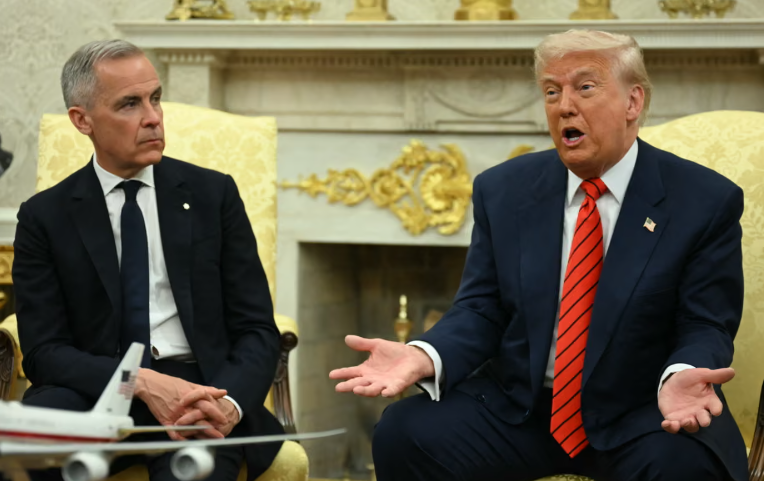
US–Canada tensions rise after President Trump withdraws Canada’s invitation to join his Board of Peace, days after Prime Minister Mark Carney warned against economic coercion in Davos.
WEBDESK – Act Global Media – January 23, 2026
Tensions between the US and Canada flared again after President Donald Trump withdrew an invitation for Canada to join his proposed “Board of Peace,” a move that follows sharp remarks by Canadian Prime Minister Mark Carney warning against economic coercion by global superpowers.
Trump announced the decision late Thursday on Truth Social, saying the board was rescinding its invitation to Canada just days after Carney said he intended to participate, with details still under negotiation. Countries seeking a permanent seat on the board are required to contribute $1 billion, according to people familiar with the framework.
The withdrawal came after Carney’s speech at the World Economic Forum in Davos, where he urged the world’s “middle powers” to unite against what he described as the weaponization of trade and finance by major powers. “Tariffs as leverage, financial infrastructure as coercion, supply chains as vulnerabilities to be exploited,” Carney said, without naming specific countries.
Trump responded forcefully on the sidelines of the forum, saying, “Canada lives because of the United States. Remember that, Mark, the next time you make your statements.” Hours earlier, Trump had posted a digitally altered map on social media depicting Canada, Greenland and Venezuela covered with the American flag.
The episode underscores the growing strain between the two longtime allies during Trump’s second term. The president has repeatedly referred to Canada as the United States’ “51st state” and has targeted it with tariffs, fueling political friction in Ottawa and Washington alike.
The Board of Peace, chaired by Trump, was initially conceived to oversee the demilitarization and reconstruction of Gaza following a prolonged war with Israel. Trump has since said he envisions a broader mandate that could ultimately rival the United Nations, a prospect that has unsettled several U.S. allies.
While the initiative has drawn support from countries including Turkey, Egypt, Saudi Arabia, Qatar and Indonesia, others have been more cautious or have declined outright. Britain has reportedly ruled out participation, citing concerns over Russia’s invitation to join. Moscow and Beijing have yet to confirm whether they will sign on.
Carney’s Davos address followed a high-profile visit to China, where he reached a trade deal with President Xi Jinping aimed at lowering tariffs and rebuilding bilateral ties. The agreement included reduced Chinese tariffs on Canadian agricultural products and expanded Canadian quotas for Chinese electric vehicle imports.
As Trump pushes an increasingly transactional foreign policy and Carney seeks to diversify Canada’s global partnerships, the latest snub highlights a widening U.S.–Canada rift that shows little sign of easing.
