



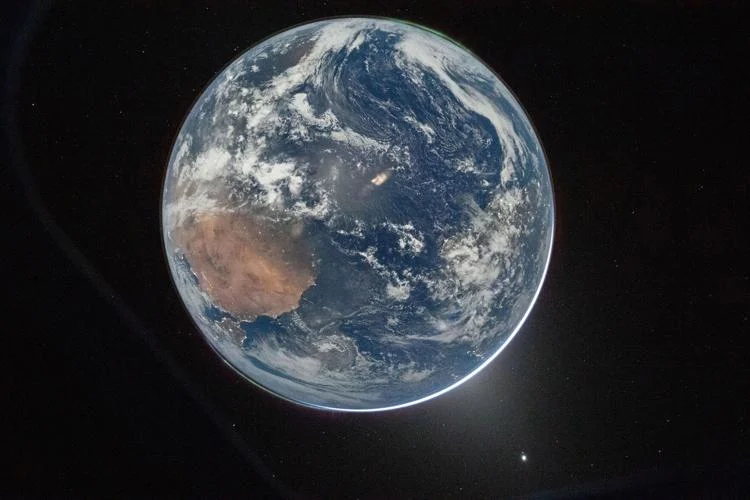
NASA has released a breathtaking new set of images of Earth captured by astronauts aboard the Artemis II mission, offering the public a rare and emotional glimpse of our planet from deep space as humanity prepares to return to the Moon.
The photos, taken during the spacecraft’s outbound trajectory beyond low Earth orbit, show Earth as a brilliant blue sphere suspended in darkness—an iconic perspective last widely seen during the Apollo era more than five decades ago. Officials say the images highlight both the technical success of the mission’s early stages and the powerful human element of space exploration.
According to mission controllers, the photographs were captured using high-resolution onboard cameras operated by the Artemis II crew as they tested navigation systems, communication links, and spacecraft orientation procedures. Engineers confirmed that the imagery also supports mission calibration and observational research objectives.
Astronauts described the moment as deeply moving. Seeing Earth from such distance reinforced the importance of international cooperation and environmental stewardship, they said in a live transmission shared shortly after the images were released.
Artemis II marks a major milestone in NASA’s broader Artemis program, which aims to return humans to the lunar surface and establish a sustainable presence near the Moon later this decade. The mission is the first crewed flight of the Orion spacecraft and serves as a critical test ahead of future lunar landing operations planned under Artemis III.
Space analysts say the release of these images has already generated global excitement, reminding audiences of the inspirational power of human spaceflight. As preparations continue for future missions, NASA officials emphasize that Artemis II is not only about exploration—but about building the foundation for humanity’s next era beyond Earth.