




Home appreciation is not “one market” and it is not evenly distributed. Two homes can look similar on paper (same size, same age, same general metro) yet grow in value at very different rates over time. The difference usually comes down to a small set of repeatable forces: local supply constraints, demand drivers (jobs, incomes, household formation), neighborhood and property-level fundamentals, and market-cycle timing.
This article explains the major factors that can cause one home to appreciate faster than another in the United States, using publicly available data and widely cited market indicators. It is written for education and general understanding only. It does not predict future prices, guarantee outcomes, or provide individualized real estate, investment, or financial advice.
One of the most important drivers of long-term appreciation is location. Factors such as access to jobs, schools, transportation, and neighborhood development can significantly influence property value. Understanding how property location affects resale value in real estate helps explain why two similar homes can grow in value at very different rates over time.
1. Start with the national reality: prices can rise nationally while outcomes vary locally
National indexes often show broad trends, but they mask local divergence.
For example, the Federal Housing Finance Agency (FHFA) publishes a national House Price Index (HPI) based largely on conforming mortgage transactions. In late 2025 reporting, FHFA noted year-over-year national price growth around the low single digits (for example, FHFA reported U.S. house prices rose 1.7% from October 2024 to October 2025 in one release).
That “national number” does not mean most homes rose exactly that much. Even in the same year:
- some metros and ZIP codes appreciate faster due to stronger demand or tighter supply,
- some flatten due to affordability ceilings or rising inventory,
- some decline due to local shocks (insurance costs, job losses, overbuilding, or weak buyer demand).
A useful mental model is this:
National trend + local market structure + property fundamentals + timing = your home’s appreciation path.
2. Appreciation is mostly a supply-and-demand story (and supply is slow)
If you want one big driver that explains why some areas appreciate faster than others, it is supply constraints.
Housing supply does not respond quickly because building takes time and approvals, labor, materials, and financing conditions can all tighten at once. When demand rises faster than supply, prices tend to rise faster.
A simple indicator of “tightness” is vacancy. The U.S. Census Bureau’s Housing Vacancies and Homeownership release (HVS) reported homeowner vacancy around 1.2% and rental vacancy around 7.1% in Q3 2025.
Low homeowner vacancy is often interpreted as “for-sale scarcity,” but remember: national vacancy rates still do not tell you which specific neighborhoods are supply-constrained.
Where supply is structurally limited (zoning restrictions, little buildable land, slow permitting, strong NIMBY pressure, high replacement costs), homes often appreciate faster over long periods—because demand has fewer places to go.
3.“Affordability ceilings” can cap appreciation, even in good locations
A home’s appreciation is also constrained by what typical buyers can afford.
The National Association of Realtors (NAR) Housing Affordability Index (HAI) tracks whether a typical family earns enough income to qualify for a mortgage on a typical home. NAR reported the index at 106.2 in October 2025 (above 100 indicates the typical family earned more than the qualifying income by their definition).
Affordability matters because it influences:
- the size of the buyer pool,
- how sensitive buyers are to mortgage-rate changes,
- whether price increases “stick” or get pushed back by longer days on market and price reductions.
In practical terms: A starter-priced home in a supply-constrained area may appreciate faster than a higher-priced home in the same area, because it stays within reach of a larger buyer pool. That is one reason “entry-level” segments can behave differently than luxury segments.
4. Income growth and job growth are demand engines (but not equally distributed)
Price growth needs purchasing power. Household income levels and income growth influence how much buyers can pay.
The U.S. Census Bureau publishes national income measures. In its “Income in the United States: 2024” report, Census describes updated income estimates for calendar year 2024.
Census also reported real median household income at $80,610 in 2023 (up 4.0% from 2022).
These national income figures matter for context, but what typically drives faster local appreciation is local income growth relative to local housing supply. Markets with expanding high-wage industries (or large inflows of high-income households) often see stronger price pressure—especially if construction cannot keep pace.
Important compliance note (Fair Housing / civil-rights safe): Income and job trends are market-level indicators. Content should never suggest targeting or excluding people by protected classes (race, religion, national origin, etc.). This article discusses market drivers in neutral, demographic-safe terms.
5.The “location premium” is real, but it is made of measurable components
People say “location, location, location,” but it helps to break location into components that show up repeatedly in U.S. pricing:
- A) Access and connectivity
- commute patterns and access to employment centers
- road networks, transit options, and airport proximity
- walkability and nearby services (retail, healthcare, parks)
- B) Supply boundaries
- natural barriers (water, protected land)
- strict zoning or limited developable land
- historic districts or slow permitting regimes
- C) Public services and local amenities
- parks and recreation
- public infrastructure quality (roads, stormwater, utilities)
- local investment and redevelopment momentum
- D) Risk and cost structure
- property tax levels and volatility
- insurance costs (especially in wind/hurricane or wildfire-prone zones)
- HOA/condo rules and fees (can reduce buyer pool if high)
Homes appreciate faster when they sit at the intersection of strong demand and constrained, high-quality “substitutes.” If buyers cannot easily find a similar home nearby at a similar price, your home has stronger pricing power over time.
6. Property taxes, insurance, and HOA fees can quietly change the buyer pool
Even if a home’s sticker price is reasonable, the total monthly ownership cost determines how many buyers can realistically carry the payment.
Property taxes
Tax burden varies dramatically by state and county. Higher taxes can reduce affordability and narrow the buyer pool especially when prices rise and assessments reset. (Property-tax rules are local; always refer readers to their county property appraiser and state statutes for specifics.)
Insurance
Insurance has become a major differentiator in many markets. If homeowners insurance premiums rise faster than incomes, or if coverage availability tightens, buyer demand can soften—even if the neighborhood remains attractive.
HOAs and condos
HOA monthly dues and special assessments can materially affect affordability and buyer psychology. Higher fees can be “worth it” for maintenance and amenities, but they can also reduce the pool of qualified buyers, especially in price-sensitive segments.
7. Home type and “substitution” matter: some inventory is easier to replace than others
Appreciation is influenced by whether comparable supply can be created easily.
Examples of homes that can be easier to replicate (often slower long-run premiums, depending on market conditions):
- homes in large subdivisions with ongoing new phases,
- areas with abundant buildable land,
- markets with fast permitting and high construction volume.
Examples that can be harder to replicate (often stronger scarcity premiums, depending on local demand):
- established neighborhoods with limited infill,
- “close-in” areas near job cores with little vacant land,
- unique lots (waterfront, protected views, unusual frontage) where substitutes are rare.
This is not a promise of performance. It is a structural explanation of why two homes can experience different demand pressure over time.
8. Condition, layout, and functional obsolescence affect “marketability,” which affects pricing power
A home can be in a strong location but still underperform if it suffers from functional issues that buyers heavily discount.
Common examples:
- poor layout (awkward kitchen placement, limited storage, low ceiling heights in key areas)
- insufficient bathrooms relative to typical buyer expectations in that market
- chronic deferred maintenance
- older systems with end-of-life risk (roof, HVAC, plumbing)
- low natural light or poor indoor-outdoor flow (market-dependent)
Homes that are “easy to finance and easy to insure” often attract a broader buyer pool. A broader buyer pool generally supports stronger pricing power.
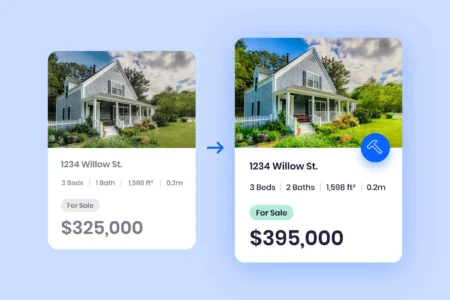
9. Renovations can help—but only when they align with the local price ceiling
Some homes appreciate slower because money is spent on upgrades that do not translate into resale value in that specific neighborhood.
A common pattern:
- In a neighborhood with a firm price ceiling, over-improving the property can reduce ROI.
- In a neighborhood with a higher ceiling and strong demand, targeted upgrades can improve marketability and reduce days on market, supporting stronger offers.
The key is not “renovate everything.” The key is: does the improvement increase the number of buyers willing to pay more, or does it simply increase your costs?
10. Market-cycle timing matters more than people want to admit
Many buyers experience appreciation differently based on when they bought in the cycle.
Two examples:
- Someone who buys near a peak can see slower growth (or short-term declines) even in a good neighborhood.
- Someone who buys during a higher-inventory period may benefit later when supply tightens.
Because this is an evergreen education article, it avoids making forecasts. The point is simply: the purchase price you start with (and the market conditions you start in) changes your appreciation “math.”
Market dynamics also play a role in appreciation. Properties that sell quickly often indicate strong demand, while homes that remain listed for longer periods may signal weaker buyer interest. Recent data on days on market and home sale price trends shows how listing speed can influence final sale prices and long-term value.
11. Credit conditions and mortgage rates influence demand sensitivity
In the U.S., most buyers use mortgage financing. Changes in mortgage rates can expand or contract the buyer pool quickly.
When rates rise, the same home price implies a higher monthly principal-and-interest payment for a buyer, which can:
- reduce the maximum price buyers qualify for,
- reduce the number of competing offers,
- lengthen market time and increase price reductions.
When rates fall, the reverse can occur, especially in supply-constrained markets.
Because this article is compliance-focused:
- it does not quote “available rates,”
- it does not offer individualized loan guidance,
- it does not encourage urgency or suggest timing the market.
It simply explains the mechanism.
12. Migration and household formation influence demand—especially in fast-changing metros
Household formation and mobility patterns affect housing demand. The Census Bureau’s products (including ACS/CPS-based reporting) are widely used to understand income and household trends.
In many fast-growth metros, price growth can accelerate when inflows of households outpace new housing delivery. In slower-growth metros, price growth may depend more on local income growth and supply reductions.
- Risks that can slow appreciation (or increase volatility)
Some factors can make appreciation more volatile or slower, even if the home is otherwise desirable:
- High insurance risk zones (wind, flood, wildfire) and rapidly rising premiums
- Local tax volatility or reassessment spikes
- Concentrated local employment risk (a “one-industry” town)
- Overbuilding (supply growth outpacing demand)
- Restrictive HOA rules that reduce buyer appeal
- Deferred infrastructure or chronic local issues (flooding, traffic bottlenecks)
Risk does not mean “bad investment.” It means buyers demand a discount for uncertainty, and that can affect appreciation.
13. A practical, neutral way to compare two homes’ appreciation potential (educational framework)
If you are comparing two homes (or two neighborhoods), a simple educational checklist is:
- A) Demand indicators (market-level)
- Are local incomes rising (relative to home prices)?
- Is local employment expanding?
- Is household growth/migration positive or stable?
- B) Supply indicators
- Is new construction easy or hard to add?
- Is homeowner vacancy low (tight resale inventory)?
- Are there structural barriers to building (land, zoning, permitting)?
- C) Cost structure
- Do taxes, insurance, and HOA dues keep the home affordable for the typical buyer pool?
- Are those costs stable or rising quickly?
- D) Property fundamentals
- Does the home match buyer preferences for that area (layout, bed/bath utility, parking, condition)?
- Is it “financeable” and “insurable” without unusual friction?
- E) Price ceiling reality
- Are you buying below, near, or above the area’s typical ceiling for similar homes?
- Is your upgrade plan aligned with what the neighborhood supports?
This checklist does not guarantee results. It simply helps readers evaluate why appreciation differs.
Summary: why some homes appreciate faster than others
Homes tend to appreciate faster when:
- they are in markets with strong demand and slow supply growth,
- they remain affordable to a large buyer pool (relative to incomes),
- they have scarcity value (hard-to-replicate location or lot),
- their total ownership cost does not deter financing-qualified buyers,
- their condition and functionality align with local buyer expectations.
Homes tend to appreciate slower (or more unevenly) when:
- supply expands quickly (easy building, abundant land),
- affordability is stretched and buyer pools shrink,
- taxes/insurance/HOA fees rise faster than incomes,
- the property suffers from functional obsolescence or deferred maintenance,
- local demand drivers weaken.
Author:
Asim Iftikhar — Real Estate Contributor, ACT Global Media
Florida Real Estate License: SL3633555
Florida Notary Commission: HH 709161
Editorial disclosure:
This article is provided for general informational purposes only and does not constitute real estate, investment, financial, mortgage, or legal advice. No content is a solicitation or inducement. All examples are educational and illustrative. Housing markets vary by location and time.
Source attribution (public, U.S.-focused references used for context):
- U.S. Federal Housing Finance Agency (FHFA) House Price Index (HPI) releases and reports.
- U.S. Census Bureau: Housing Vacancies and Homeownership (HVS) releases.
- U.S. Census Bureau: Income reporting for U.S. households (CPS/ASEC-based “Income in the United States” series).
- National Association of Realtors (NAR): Housing Affordability Index reporting and interpretation.