



Why Population Growth Matters for Housing Markets
Population growth is one of the most powerful forces shaping real estate markets in Florida. When more people move into a region, housing demand increases, which can influence home prices, rental markets, infrastructure development, and economic expansion.
Florida has emerged as one of the fastest-growing states in the United States over the past decade. Migration from other states, international immigration, and strong job growth have contributed to sustained population increases across many Florida cities.
Recent population estimates released by the U.S. Census Bureau indicate that Florida’s population reached approximately 23.37 million residents in 2024, making it the third-most-populous state in the country.
Between 2020 and 2024 alone, Florida’s population grew by about 8.24%, making it the fastest-growing state during that period.
Population growth in Florida is largely driven by migration. The Census Bureau reported that net international migration added more than 411,000 residents to Florida’s population in a single year, making it one of the largest migration destinations in the United States.
These demographic changes have significant implications for the housing market.
When population growth accelerates:
- housing demand increases
- rental markets expand
- new construction activity rises
- infrastructure development follows population centers.
Understanding population trends therefore provides important insight into future housing demand and real estate investment opportunities.
This article provides a comprehensive research-based analysis of population growth trends across Florida cities, incorporating data from:
- U.S. Census Bureau
- American Community Survey (ACS)
- National Association of Realtors (NAR)
- U.S. Department of Housing and Urban Development (HUD).
The goal is to explain how demographic expansion is reshaping Florida’s urban landscape and influencing real estate markets across the state.
Florida’s Population Growth in a National Context
Florida’s population expansion reflects a broader demographic trend occurring across the southern United States, often referred to as the Sun Belt migration trend.
The Sun Belt region—stretching from the southeastern to southwestern United States—has experienced significant population growth due to:
- lower taxes
- warmer climate
- relatively affordable housing
- expanding job markets.
Between 2023 and 2024, Florida added more than 467,000 new residents, according to Census population estimates.
During the same period, Florida’s population growth rate was about 2.04%, the fastest among all U.S. states.
By comparison, the overall U.S. population grew by only about 1% annually, highlighting Florida’s exceptional growth rate.
This demographic expansion has made Florida one of the most dynamic housing markets in the country.
Key Drivers of Population Growth in Florida
Several factors contribute to Florida’s strong population growth.
Domestic Migration
Domestic migration refers to people moving from one U.S. state to another.
Florida has attracted residents from high-cost states such as:
- New York
- California
- Illinois
- New Jersey.
Many migrants cite lower taxes and relatively affordable housing as major reasons for relocating.
International Migration
Florida is also a major gateway for international immigrants, particularly from:
- Latin America
- the Caribbean
- Europe.
International migration accounted for a large portion of Florida’s population increase in recent years.
Retirement Migration
Florida has long been a popular destination for retirees due to:
- warm climate
- absence of state income tax
- extensive healthcare infrastructure.
Economic Expansion
Florida’s economy has diversified significantly in recent decades.
Key growth sectors include:
- tourism and hospitality
- healthcare
- logistics and transportation
- financial services
- technology.
These industries attract workers and families seeking employment opportunities.
Fastest-Growing Cities in Florida
Population growth varies significantly across Florida cities.
Some cities are experiencing rapid expansion due to new housing developments and migration trends.
Examples of fast-growing cities include:
- Port St. Lucie
- North Port
- Cape Coral
- Palm Bay.
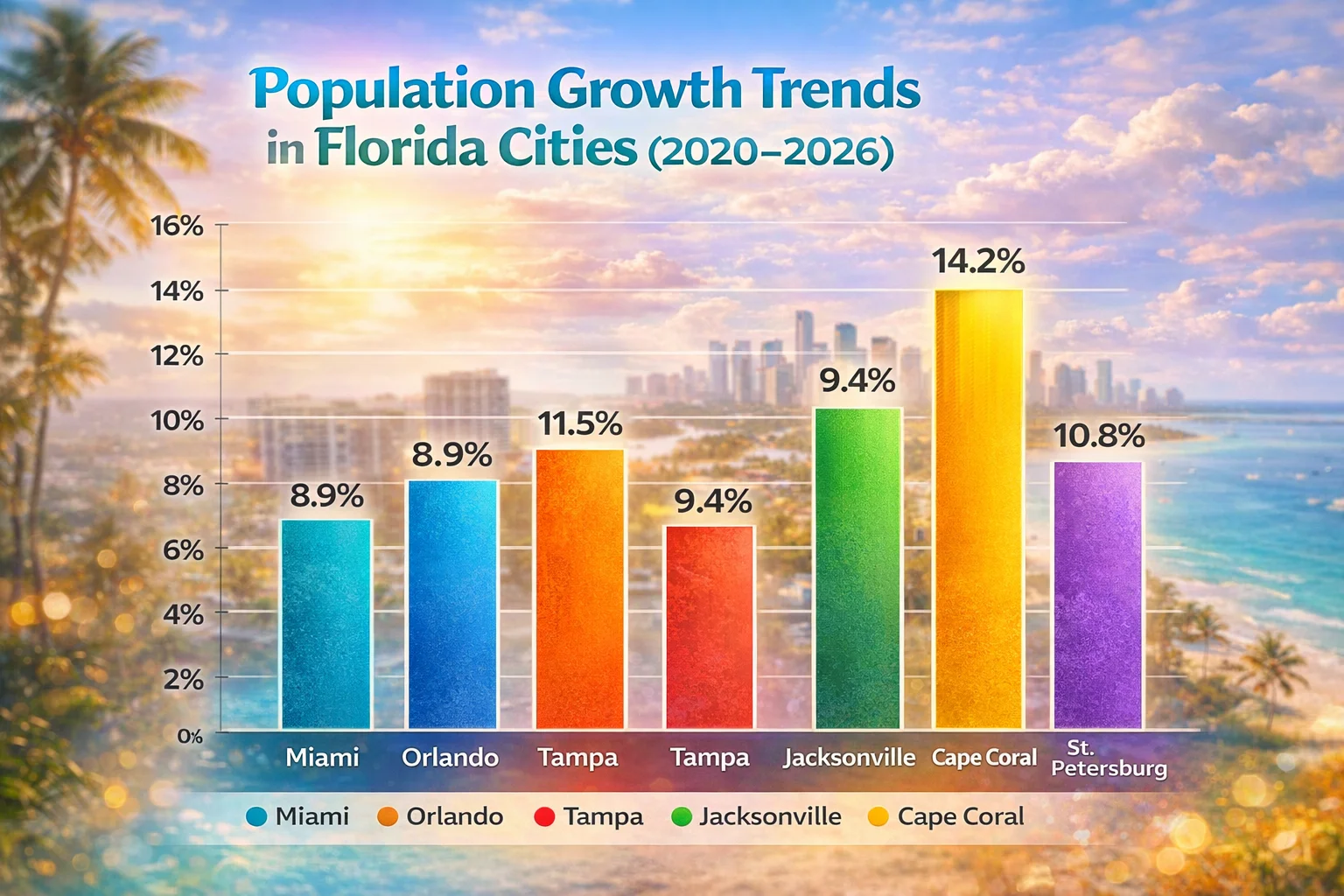
Population estimates show that Port St. Lucie grew by approximately 5.7% in one year, reaching a population of about 245,021 residents.
Palm Bay experienced similar growth, increasing by 4.9% to about 135,599 residents.
Cape Coral also recorded strong growth, with population increases of around 3.5% annually.
These cities illustrate how population expansion is occurring across multiple regions of the state.
Major Metropolitan Areas Driving Growth
Florida’s largest metropolitan areas are responsible for much of the state’s population growth.
Orlando-Kissimmee-Sanford
The Orlando metropolitan area remains one of the fastest-growing regions in Florida.
Between 2022 and 2023, the metro area added approximately 54,916 residents, placing it among the largest population increases in the United States.
Tourism, technology expansion, and population migration continue to drive housing demand in Central Florida.
Tampa-St. Petersburg-Clearwater
The Tampa Bay region has also experienced strong population growth.
Between 2022 and 2023, the metro area gained about 51,622 residents, making it one of the fastest-growing metro regions nationwide.
Economic growth in finance, healthcare, and technology has contributed to Tampa’s expanding population.
Miami-Fort Lauderdale-West Palm Beach
South Florida remains one of the largest population centers in the state.
The metropolitan area added approximately 43,387 residents in a single year, reflecting strong migration and economic activity.
International migration plays a particularly significant role in South Florida’s population growth.
Emerging Growth Cities in Florida
While major metropolitan areas attract significant population increases, several mid-size cities are experiencing rapid expansion.
Lakeland
Lakeland has emerged as one of the fastest-growing cities in Florida.
Located between Tampa and Orlando, the city benefits from:
- affordable housing
- proximity to major employment centers
- expanding logistics industry.
Recent studies show Lakeland’s population increased more than 34% over the past decade, making it one of the fastest-growing “boomtowns” in the United States.
Ocala
Ocala has become one of the fastest-growing metropolitan areas in the country.
The Census Bureau reported that the Ocala metro area grew by approximately 4% in a single year, making it the fastest-growing metro area in the United States during that period.
Growth is driven by:
- affordable housing
- equestrian industry
- logistics and manufacturing employment.
Port St. Lucie
Port St. Lucie has experienced rapid population growth as migrants relocate from South Florida’s high-cost housing markets.
The city’s population growth rate has been among the highest in the state.
Housing Demand and Population Growth
Population growth directly affects housing demand.
When population increases:
- more housing units are required
- rental demand rises
- home prices may increase.
Housing supply must expand to accommodate new residents.
The U.S. Census Bureau reported that the national housing stock increased by about 1.4 million housing units between 2023 and 2024, reflecting ongoing construction activity across growing regions such as Florida.
However, housing supply often struggles to keep pace with rapid population growth, which can lead to rising housing costs.
Migration Patterns and Housing Markets
Migration patterns strongly influence local housing markets.
Areas experiencing strong in-migration often see:
- increased housing demand
- rising home prices
- increased construction activity.
Conversely, regions experiencing population decline may face slower housing demand.
Florida’s population growth has therefore contributed to rising home prices and rents in many markets.
Housing economists have noted that demographic expansion plays a major role in shaping housing market cycles.
Population Growth and Real Estate Investment
Real estate investors closely monitor population growth because demographic expansion often indicates future housing demand.
Cities experiencing strong population growth may offer:
- higher rental demand
- lower vacancy rates
- long-term property appreciation.
However, investors must also consider factors such as:
- infrastructure capacity
- housing supply
- economic diversification.
Population growth alone does not guarantee strong real estate returns, but it is an important indicator of market potential.
Future Population Projections for Florida
Population forecasts suggest Florida will continue to grow in the coming years.
State demographic projections estimate that Florida could add hundreds of thousands of new residents annually through the late 2020s.
In fact, population projections suggest the state may add the equivalent of a new city roughly the size of Orlando every year through continued migration and natural population growth.
These trends suggest that housing demand will likely remain strong across many Florida markets.
Conclusion
Florida has become one of the fastest-growing states in the United States due to strong migration trends, economic expansion, and lifestyle advantages.
Key population trends include:
- Florida’s population exceeded 23.3 million residents in 2024, according to Census estimates.
- The state’s population grew about 8.24% between 2020 and 2024, the fastest growth rate nationwide.
- Major metro areas such as Orlando, Tampa, and Miami are experiencing significant population increases.
- Mid-size cities such as Lakeland, Port St. Lucie, and Ocala are emerging as some of the fastest-growing housing markets in the state.
Population growth remains one of the most important drivers of housing demand and real estate development in Florida.
Understanding these demographic trends can help policymakers, investors, and residents better evaluate the future of Florida’s rapidly expanding urban landscape.
Author
Asim Iftikhar — Real Estate Contributor, ACT Global Media
Florida Real Estate License: SL3633555
Florida Notary Commission: HH 709161
Asim Iftikhar contributes educational real estate content focused on U.S. residential processes, market structure, and consumer understanding. Content is informational and general in nature.
Editorial Disclosure
This article is provided for educational and informational purposes only and does not constitute real estate, financial, or investment advice. Population trends and housing markets may change over time. Readers should consult official government data sources and licensed professionals when evaluating housing or real estate decisions.