


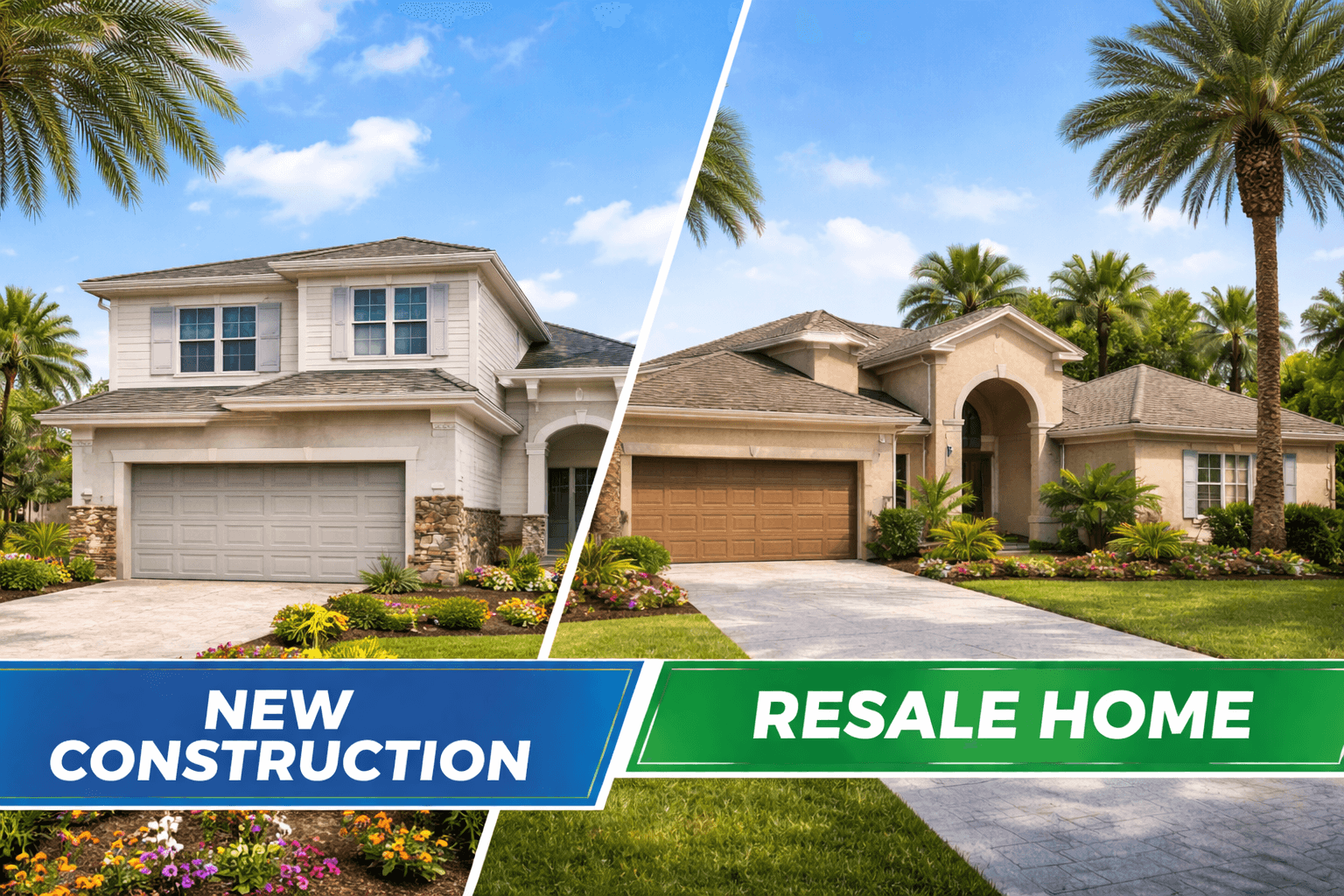
Orlando-area buyers in 2026 are making decisions in a market shaped by three forces at once: (1) affordability pressure from elevated prices and borrowing costs, (2) uneven inventory across neighborhoods and price points, and (3) a meaningful pipeline of new construction in parts of Central Florida. Choosing new construction versus an existing (resale) home property in Orlando isn’t just a preference decision—it often changes your total monthly housing cost, repair risk, timeline, negotiation leverage, and long-term resale dynamics.
This educational guide explains how the decision typically works in the Orlando region, using publicly available market and housing indicators. It focuses on structures, numbers, and tradeoffs—not personalized advice.
Orlando market snapshot: why the “new vs resale” decision matters in 2026
Even when headline prices look “stable,” affordability can shift quickly because monthly payment drivers (purchase price, interest rates, insurance, taxes, HOA, maintenance) move differently over time.
The Orlando Regional REALTOR® Association (ORRA) market overview for 2025 shows:
- Orlando area median price (all 2025): $385,000 (Year-to-date)
- December 2025 median price: $380,313
- 2025 total sales: 26,721 (vs 28,321 in 2024)
- 2025 new listings: 44,940 (vs 44,749 in 2024)
- The same ORRA report includes affordability index tables (based on standard down payment / loan-to-value assumptions) that illustrate how payment pressure remains a key constraint even when median prices don’t spike month-to-month.
Interpretation (educational): When transaction volume cools, buyers often get more choice and negotiating room—but not evenly. Some submarkets and property types remain competitive, and new construction can behave differently than resale in both pricing and incentives.
Definitions: what “new construction” means in Orlando
In Central Florida, “new construction” commonly includes:
- Production builder communities (large subdivisions; standardized plans; HOA almost always)
- Build-to-order in a community (you choose a lot and plan; builder controls timeline and finishes)
- Spec homes (already built or near completion; you buy “as-is” finishes)
- Custom homes (land + custom builder; more complexity, permitting, and cost variability)
Resale homes include everything from 1970s block homes to newer 2018–2023 builds that are still “existing” inventory.
The core tradeoff: certainty vs flexibility
A useful way to compare:
New construction tends to optimize for:
- Lower immediate repair risk (new roof, new systems, new appliances)
- Predictable layout and modern standards
- Builder incentives (often used to move inventory or maintain absorption pace)
- Energy efficiency features (varies by builder and specifications)
Resale tends to optimize for:
- Neighborhood selection (mature areas; closer-in location; established schools/amenities)
- Lot characteristics (trees, larger lots, no HOA in some areas)
- Faster move-in (if the home is vacant and inspection/financing timelines align)
- Potential price negotiation tied to condition, DOM, or seller urgency
Neither is “better” in general. The right choice is often the one that matches your property in Orlando budget structure (cash at closing vs monthly payment), timeline, and tolerance for property condition variability.
What the data says nationally about builder incentives (and why it matters locally)
New-construction economics differ from resale because builders often try to protect neighborhood pricing by offering incentives instead of headline price cuts. In 2024–2025, national new-home markets frequently featured incentives such as closing cost credits or mortgage rate buydowns (terms vary widely and depend on buyer qualification and lender/builder programs).
For example, national new-home reporting has highlighted that builders commonly use incentives and, in some periods, have reported offering incentives at high rates among surveyed builders.
Orlando relevance: Central Florida has many production communities. Incentives can materially affect cash-to-close or monthly payment in a way that resale sellers typically cannot match (because resale sellers don’t have a captive lending/closing ecosystem). However, incentives are not uniform and should be evaluated against total cost and contract terms.
New construction vs resale: the “real cost” categories buyers underestimate
1) HOA and CDD-style costs (common in new communities)
Many new communities have:
- HOA dues (monthly/quarterly)
- Amenity fees
- Sometimes additional district assessments (varies by location and community structure)
Why it matters: A home can “fit” your purchase price range but still exceed your comfort level once HOA/amenities are included.
2) Insurance volatility (Florida reality)
Florida homeowners insurance pricing and availability can significantly affect the monthly payment. Newer roofs and wind-mitigation features can help in many cases, but insurance pricing is carrier-specific and property-specific.
New vs resale: New builds may have fewer near-term roof concerns, but that doesn’t guarantee lower premiums. Proximity to water, wind exposure, rebuild costs, and claim trends still drive pricing.
3) Property taxes and assessment timing
Property taxes can reset after a sale. New construction can also create “surprise” changes when:
- The prior tax bill reflected land-only assessment, then improves after completion
- The first full assessment year triggers a higher bill than the initial escrow estimate
Educational note: Buyers often focus on the listing price but underestimate how tax assessment timing can change the monthly payment.
4) Maintenance timeline
- Resale homes may require near-term capex (HVAC, plumbing, electrical, roof, water heater)
- New homes may have lower early-year maintenance but can still have warranty coordination issues and normal wear items
Competition and negotiation: where buyers often have more leverage
Resale leverage signals (common indicators)
Resale leverage often increases when you see:
- Higher days on market (DOM)
- Multiple price reductions
- Seller concessions becoming more common
- Higher inventory relative to demand in a specific neighborhood/price band
New construction leverage signals
Builder leverage can change based on:
- Phase releases (lots released in waves)
- Spec inventory counts
- Quarter-end / year-end sales pacing (builders track absorption)
- Mortgage market conditions affecting buyer traffic
Key difference: Builders may prefer incentives over price reductions to protect community comp valuations. Resale sellers may reduce price more directly if they need to sell within a timeframe.
Location tradeoffs: the Orlando pattern most buyers experience
In the Orlando metro, a common pattern is:
- New construction clusters: more available in growth corridors and developing areas (often farther from the core, but not always)
- Resale clusters: broader variety in established neighborhoods and infill areas
This creates a practical tradeoff:
- New construction may offer a newer home and structured amenities
- Resale may offer proximity, lot uniqueness, and neighborhood maturity
Resale advantage: “Location scarcity” can support long-term demand in established areas where it’s difficult to add supply.
New construction advantage: New supply can relieve price pressure in certain submarkets by expanding choices.
Build timeline and contract differences (high-impact differences)
Resale contract flow (typical)
- Offer → inspection period → appraisal/financing → closing
Buyers often focus on inspection outcomes, seller repairs, and appraisal alignment.
New construction contract flow (typical)
- Deposit → build timeline milestones → selections → inspections/walkthroughs → closing
Buyers often focus on build delays, change orders, and warranty documentation.
Common misunderstanding: Many buyers assume new construction means “less risk.” In reality, the risk changes form—from repair risk to timeline, contract, and delivery risk.
Appraisal and resale dynamics: why “comps” can behave differently
Resale homes are priced off nearby closed sales. New construction communities can shape comp behavior through:
- Phase pricing (later phases can be priced higher)
- Incentives that don’t always show up in headline prices
- Spec home pricing to manage inventory
Educational implication: When comparing new vs resale, it’s useful to distinguish:
- The contract price
- The net cost after incentives/credits
- The monthly payment impact
- The likely neighborhood resale comp set (especially if the new home is in a rapidly expanding area)
Supply pipeline context: permits and construction activity (why it affects choices)
Housing supply and construction activity influence how much new inventory can come online. Federal permitting data provides a window into this pipeline. The U.S. Census Bureau Building Permits Survey shows permitting activity by geography, which analysts often use to understand the future flow of new units.
Educational takeaway: If permitting/construction is robust in certain corridors, buyers may see more new-home options and potentially more builder competition. In areas with limited new supply, resale competition can remain firmer.
Practical comparison framework: how to compare apples-to-apples
When buyers compare new vs resale property in Orlando, confusion often comes from mixing different “cost buckets.” A clearer approach is to compare these four layers:
Layer A: Purchase price and upfront cash
- Down payment
- Closing costs
- Builder credits or seller concessions
- Required deposits (new construction often has structured deposits)
Layer B: Monthly payment structure
- Principal/interest (loan terms vary by borrower and lender)
- Property taxes (estimate carefully; reassessment matters)
- Insurance (quote the exact address when possible)
- HOA/amenities
Layer C: First 24 months risk profile
- Resale: repairs/capex likelihood
- New: timeline risk, warranty processes, punch-list issues
Layer D: Resale outlook and liquidity
- Neighborhood desirability and scarcity
- School and job access
- Future competing supply (new phases nearby)
- Property uniqueness (lot, layout, upgrades)
This framework keeps the comparison educational and neutral while focusing on total ownership economics.
Orlando-specific decision patterns (what tends to happen in practice)
While every household is different, several Orlando-area patterns are common:
- First-time buyers often consider new construction when incentives help the monthly payment or reduce cash-to-close—especially when resale inventory in a desired price band is tight.
- Move-up buyers may prefer resale for established neighborhoods and commute patterns, especially if HOA constraints are a negative.
- Investors often weigh tenant demand, HOA rules (rental restrictions), insurance costs, and neighborhood rent ceilings. New construction can work in some corridors, but rental regulations vary community-by-community.
These are market-structure observations, not recommendations.
Summary: the “right” choice is usually the one that matches your cost structure
In 2026, Orlando buyers often find that:
- New construction can be compelling when incentives, warranties, and newer systems reduce near-term risk and support predictable ownership—especially in fast-growing corridors.
- Resale can be compelling when location scarcity, lot uniqueness, and established neighborhood dynamics matter more than immediate “newness.”
Orlando’s median pricing and market activity (as reflected in ORRA reporting) reinforces that affordability is driven by more than price alone, making total-cost comparisons essential.
Author Credit
Written by:
Asim Iftikhar — Real Estate Contributor, ACT Global Media
Florida Real Estate Sales Associate License: SL3633555
Florida Notary Commission: HH 709161
Editorial Disclosure
This article is provided for general informational purposes only and does not constitute real estate, legal, financial, mortgage, or investment advice. Housing and financing conditions vary by neighborhood, property type, lender, insurer, and individual circumstances. Readers should consult qualified professionals for guidance specific to their situation.