

Introduction
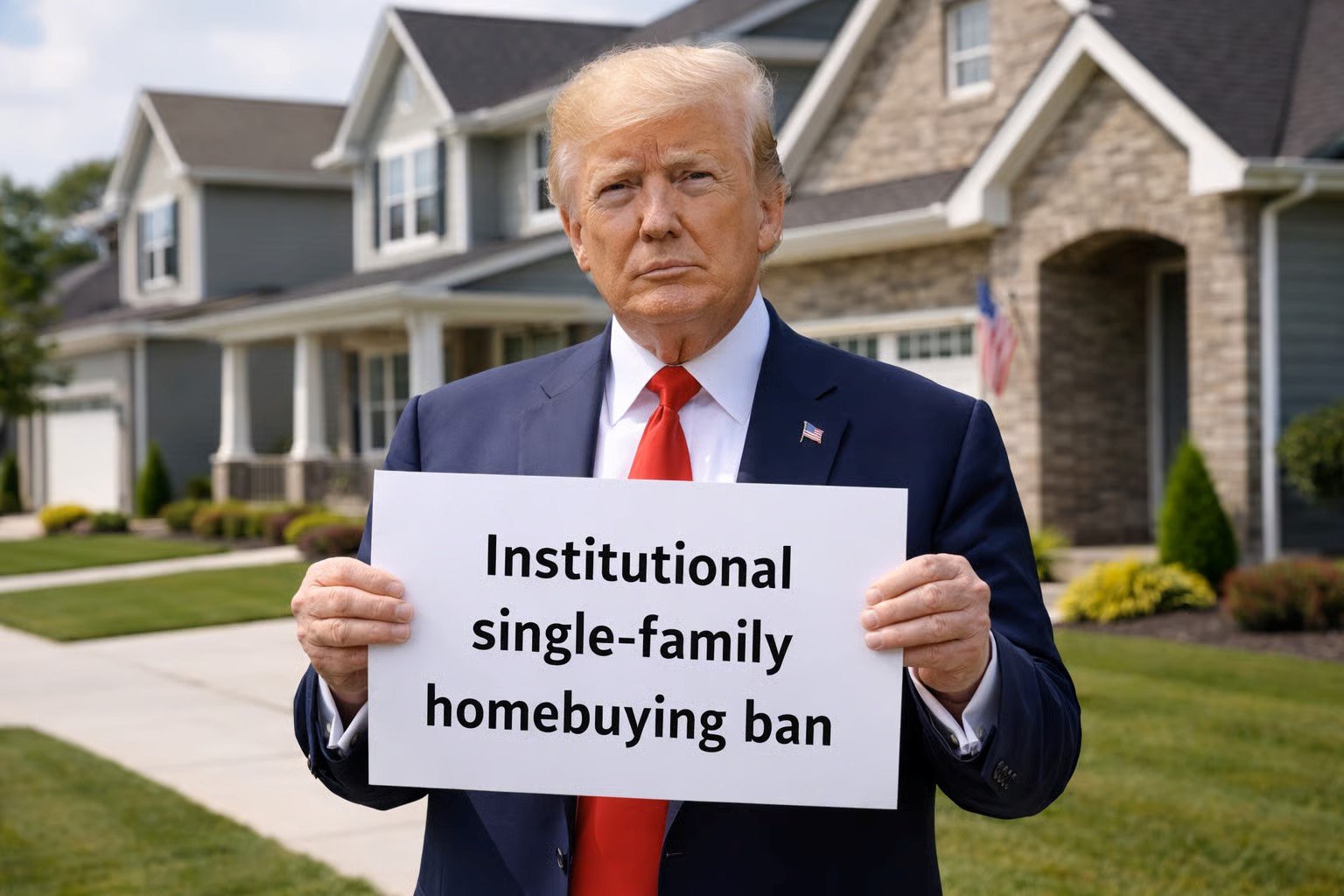
President Donald Trump said he is taking steps to “ban large institutional investors from buying more single-family homes,” and called on Congress to codify the policy. At the time of writing, public details about scope, definitions, and enforcement mechanics are still developing (for example: what counts as “large,” whether it applies to affiliates, whether “build-to-rent” is treated differently, and how exceptions would work).
This explainer summarizes what credible, publicly available U.S. data suggests the policy could—and could not—change, and why effects would likely differ sharply by metro area.
1) Start with definitions: “institutional investor” isn’t the same as “investor”
In housing policy discussions, “institutional investor” usually refers to large, professionally managed firms that own (or control) portfolios of single-family homes—often described in research as owners with 100+ homes or “mega-investors” with 1,000+ homes (definitions vary by study). By contrast, “investor activity” in the market overall includes many small investors (sometimes called “mom-and-pop” landlords) who own a handful of properties.
That distinction matters because market data consistently shows that most investor participation is not coming from the largest institutions.
- Realtor.com reports that in Q2 2025, investors accounted for 10.8% of home purchases, and more than 60% of investor activity came from small investors (as defined in their methodology).
- This implies that a policy targeting only “large institutions” could leave the majority of investor demand untouched—depending on where the “large” threshold is set.
2) Nationally, large institutions are a small slice of the single-family universe
Large institutional investors draw outsized attention, but multiple analyses suggest their national share of single-family rentals (SFR) is relatively small.
- The Hamilton Project summarizes research indicating large institutional investors own just over ~3% of single-family rental stock nationally (and emphasizes that ownership is much more concentrated in certain markets).
- Other recent commentary and policy analysis also puts institutional ownership at very low single-digit percentages nationally, sometimes cited as under 1% of single-family homes (note: “single-family homes” is broader than “single-family rentals,” so comparisons depend on which denominator a study uses).
What this means in practical terms: even a perfectly enforced national ban on new acquisitions by large institutions would likely create only modest “freed inventory” nationally, because the targeted segment is small relative to total housing stock.
3) Where it could matter: a handful of metros with high concentration
Even if national impact is limited, a ban could have more bite in a small number of metro areas where institutional ownership is unusually concentrated.
A Realtor.com analysis (discussing widely cited research) highlights examples such as:
- Atlanta: institutional investors owning ~27% of single-family rental homes
- Jacksonville: ~22%
- Charlotte: ~20%
The Hamilton Project similarly emphasizes that institutional SFR ownership can be “quite high” in certain markets (including parts of the Southeast and Southwest).
Local-market implication: in places where institutional acquisition pipelines are material, restricting further acquisitions could gradually change the marginal buyer mix—but effects would depend on (a) how much those firms would have bought otherwise, (b) whether small investors step in, and (c) whether sellers shift strategies (e.g., selling to other investors vs. owner-occupants).
4) A key tradeoff: homebuyer access vs. rental supply dynamics
A common reason these firms buy single-family homes is to operate them as rentals—especially in suburban areas where multifamily supply is limited.
A policy that reduces institutional participation could, in some neighborhoods, create more purchase opportunities for owner-occupants over time. But it could also affect the rental pipeline in at least three ways:
- Who buys the home instead?
If large institutions are restricted, small investors may fill the gap (the “demand” may not disappear, it may just change hands). Realtor.com notes evidence that large institutions were already a narrow slice of activity and that small investors dominate investor participation in many periods. - Tenant turnover / “return to market” friction
Single-family rentals don’t instantly convert back into for-sale inventory for owner-occupants because homes may have tenants in place, lease terms, and property management operations—so the timeline for any inventory effect can be slow. - Rent pressure depends on local supply conditions
In tight rental markets, any reduction in rental supply growth can push competition toward the remaining rentals—unless new construction or turnover offsets it.
For macro context, the Census Housing Vacancy Survey reported Q3 2025 rental vacancy at 7.1% and homeowner vacancy at 1.2%—data points often used as broad indicators of rental tightness and for-sale scarcity (though they do not isolate single-family rentals).
5) The “root cause” debate: affordability as a supply problem
Many housing economists argue that affordability constraints are primarily driven by undersupply and constrained inventory, meaning investor restrictions alone may not address the main pressure.
Several mainstream indicators point to persistent affordability stress:
- NAR’s affordability/supply research highlights how limited the share of listings can be for middle-income households (e.g., as of March 2025, a household earning $75,000 could afford ~21.2% of listings; a household earning $50,000 could afford ~8.7% of listings).
- HUD’s Worst Case Housing Needs (2025 Report to Congress) shows severe rent burdens remain elevated at ~8.46 million households (2021–2023), underscoring affordability strain for very low-income renters.
- Congress’s CRS has summarized multiple “housing shortage” estimates (often in the millions of units), illustrating that reputable estimates vary but frequently point to substantial underproduction.
Policy implication: if the goal is affordability improvement at scale, many analysts expect the largest effects from measures that increase supply, speed delivery, or reduce barriers to building—while investor restrictions may be more “surgical” and localized.
6) What to watch next (implementation details that change the outcome)
Because outcomes depend heavily on policy design, these are the “make-or-break” specifics to monitor as details emerge:
- Definition threshold: 10 homes? 100? 1,000? (The narrower the definition, the smaller the direct impact.)
- Entity rules: How affiliates, LLCs, funds, and related entities are treated.
- Geographic scope: National vs. targeted “hot spot” metros.
- New construction carveouts: Whether build-to-rent communities or developer pipelines are exempt.
- Enforcement mechanics: Reporting, penalties, and coordination with state deed/recording systems.
- Timeline: Immediate vs. phased implementation.
The White House has already published a fact sheet framing the initiative as an executive action tied to banning large institutions from competing with “Main Street” homebuyers, but legislative codification (as mentioned) would still require Congressional action and detailed statutory language.
Author Informaton:
Written by:
Asim Iftikhar — Real Estate Contributor, ACT Global Media
Editorial disclosure:
This article is provided for general informational and educational purposes only. It does not constitute real estate, legal, financial, investment, or mortgage advice.
Regulatory / data notice:
Information is based on publicly available U.S. sources (including government and major research/industry publications). Policies, market conditions, and definitions used in third-party studies may vary over time and by methodology. Nothing in this article should be interpreted as a solicitation, inducement, or recommendation to buy, sell, or finance real estate.
