

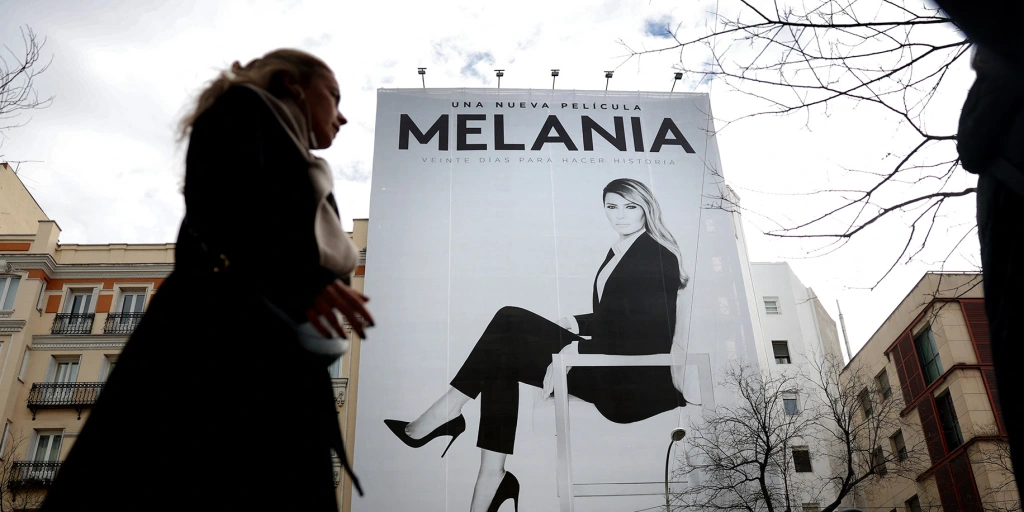
The release of a documentary centered on Melania Trump has produced sharply contrasting reactions across the United States, underscoring the country’s persistent political polarization. From nearly empty theaters in some cities to sold-out screenings in others, audience turnout has varied dramatically depending on location and political leanings.
In traditionally liberal urban centers, early screenings reportedly drew sparse crowds, with critics dismissing the film as carefully curated and politically adjacent. Some viewers questioned the project’s purpose, arguing that it offers limited insight into Melania Trump’s inner life or her role during her husband’s presidency. Reviews in these areas often framed the documentary as an exercise in image control rather than a revealing portrait.
By contrast, theaters in conservative-leaning regions saw packed houses and enthusiastic audiences. Supporters praised the documentary for portraying Melania Trump as a private, resilient figure who endured intense public scrutiny. Many viewers described the film as a rare opportunity to see her perspective, separate from the broader political controversies surrounding former President Donald Trump.
Industry analysts note that the uneven box office response reflects more than interest in the film itself—it mirrors America’s fractured political and cultural landscape. Documentaries tied to high-profile political figures increasingly function as litmus tests for partisan identity, attracting audiences who feel represented while alienating others.
The mixed reception also highlights how entertainment spaces have become extensions of political discourse. Social media reactions to the documentary have followed similar lines, with praise and criticism often aligned with ideological affiliation rather than cinematic merit.
As the documentary continues its limited theatrical run, distributors say attendance patterns remain consistent with regional political divides. Observers suggest the film’s legacy may rest less on its artistic impact and more on what it reveals about audience behavior in a polarized era.
Ultimately, the contrasting responses to the Melania Trump documentary illustrate how even cultural products are now filtered through political identity—turning movie theaters into quiet reflections of America’s broader divisions.
