



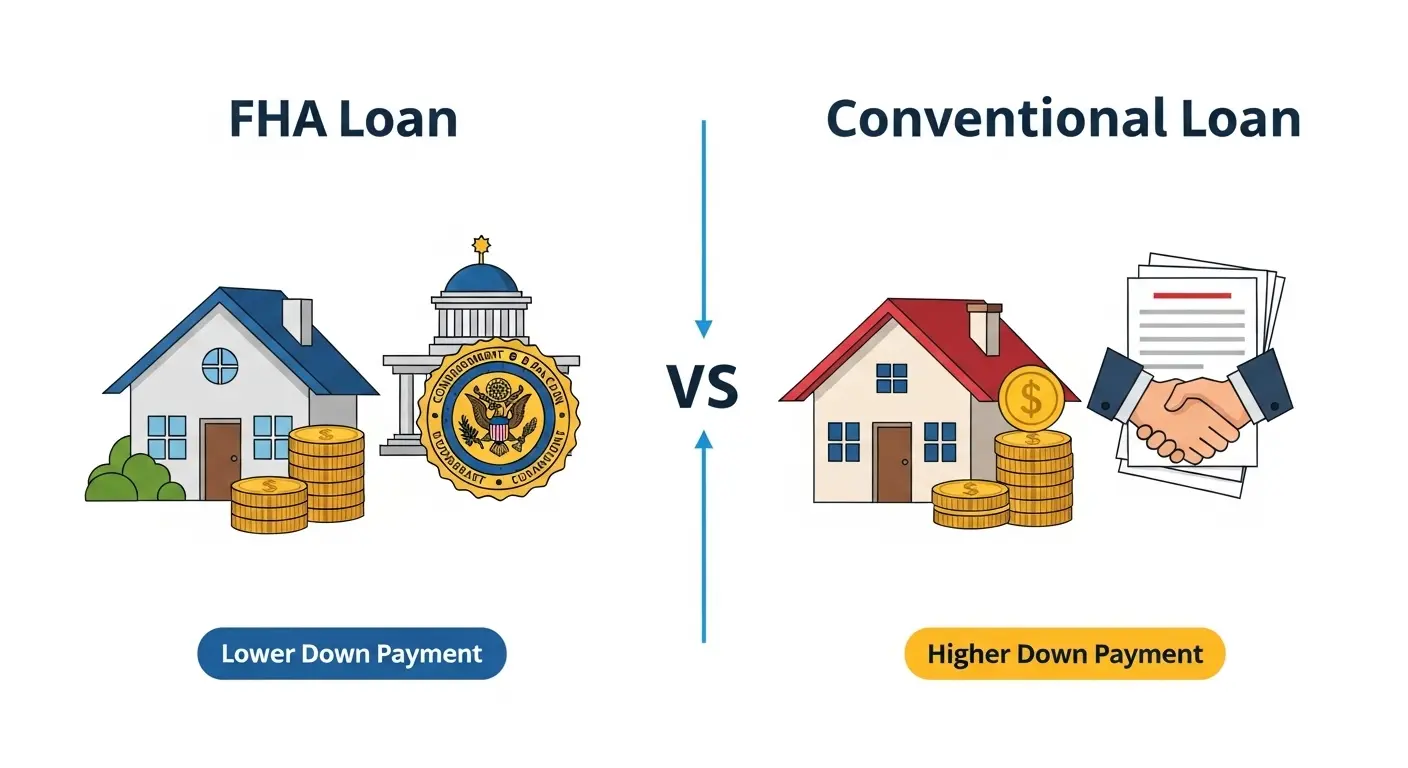
Most Florida buyers ask the wrong question when comparing FHA and conventional loans. They ask which one has lower requirements, when the better question is which one produces the lower total cost for their specific credit score, down payment, and expected holding period. The answer changes based on those three variables, and getting it wrong means either paying thousands more per year in mortgage insurance than necessary or leaving a qualifying option on the table that a different product structure would have provided.
The Freddie Mac Primary Mortgage Market Survey benchmark for a 30-year fixed mortgage stood at 6.37% as of April 9, 2026. FHA mortgage rates in mid-April 2026 were running approximately 6.08% to 6.13%, per Fortune/Optimal Blue rate lock datameaningfully below the conventional benchmark for equivalent borrower profiles. That rate gap matters: on a $285,000 FHA loan, the difference between 6.10% and 6.40% is $55 per month. Over 5 years, that is $3,300. But FHA carries mandatory mortgage insurance that conventional loans can eventually shedand for many Florida buyers, that mortgage insurance has no exit until the loan is refinanced or paid off.
This article gives you the full cost comparison: FHA versus conventional at three credit score tiers, with Florida-specific loan limits, actual mortgage insurance calculations, and a framework for determining which product produces the lower total cost based on how long you plan to keep the loan. By the end, you will have a specific answer for your situationnot a generic recommendation, but the mathematical comparison that your decision should be built on.
What You Will Learn From This Article
- FHA rates in April 2026 are approximately 0.25% to 0.30% lower than conventional rates for borrowers in the 620 to 720 credit score range. That rate advantage is partially or fully offset by FHA’s mandatory mortgage insurance, depending on how long the borrower keeps the loan.
- FHA’s mortgage insurance premium (MIP) consists of two components: an upfront premium of 1.75% of the base loan amount (typically financed in) and an annual premium of 0.55% for most borrowers. On a $280,000 FHA loan, the upfront MIP adds $4,900 to the loan balance and the annual MIP runs approximately $127 per month.
- FHA MIP for loans originated after June 3, 2013 with less than 10% down is permanent for the life of the loan. There is no automatic cancellation mechanism regardless of how much equity the borrower accumulates. The only exit is to refinance into a conventional loan or pay off the loan entirely.
- Conventional PMI cancels automatically when the loan balance reaches 78% of the original purchase price under the Homeowners Protection Act of 1998. Borrowers can also request cancellation at 80% LTV. For a buyer at 5% down on a $300,000 home, conventional PMI auto-cancels in approximately year 11 to 12 under standard amortization.
- The FHA loan limit for most Florida counties in 2026 is $498,257 for a 1-unit property, per HUD FHA Mortgage Limits. High-cost counties including Miami-Dade, Palm Beach, and Monroe are at $621,000. These limits determine whether FHA is even available for the specific property being purchased.
- For buyers with credit scores between 620 and 679, FHA often produces a lower total monthly payment than conventional because the rate differential more than offsets the mortgage insurance cost for the first several years. For buyers above 720 credit, conventional at 5% to 10% down typically wins on total cost, especially beyond year 7.
- Running the full cost comparison requires modeling the break-even year: the point at which the conventional loan’s declining PMI cost crosses below the FHA loan’s fixed MIP cost. That break-even year is the primary decision driver for borrowers who do not plan to hold the loan indefinitely.
FHA vs Conventional: The Core Structural Differences That Drive the Cost Analysis
Before calculating total cost, the structural difference between FHA and conventional needs to be understood at the level of what each program is actually doing and why.
FHA loans are insured by the Federal Housing Administration under HUD. The mortgage insurance you pay as an FHA borrower is not protecting youit is protecting the lender against your default. Because the federal government is backing the loan, lenders accept lower credit scores, higher debt-to-income ratios, and smaller down payments than they would on conventional products. The insurance cost is the mechanism that makes that risk acceptable to the lender. FHA insurance cannot be canceled except under specific conditions because the program was designed to cover lenders even after the borrower has built equitythe insurance is tied to the loan product, not to the remaining risk of default.
Conventional loans (Fannie Mae and Freddie Mac) are not government-insured. When a conventional lender requires PMI on a loan with less than 20% down, that PMI is private insurance covering the lender. Because it is private, it operates under the Homeowners Protection Act of 1998, which mandates cancellation when the loan reaches 78% LTV and allows borrower-requested cancellation at 80% LTV. PMI is risk-adjusted: the higher your credit score and the less you borrow relative to the home’s value, the lower your PMI rate.
The key insight: FHA and conventional are not competing versions of the same product. They are structurally different products with different risk profiles, different insurance mechanisms, and different cost trajectories over time. The right choice is determined by where your credit profile and down payment place you in the risk-pricing matrix of each program, not by which program sounds better.
The FHA Loan Limits That Govern Florida Market Access in 2026
Before running any cost comparison, confirm whether FHA financing is available for the property you are targeting. HUD’s 2026 FHA loan limits by Florida county determine the maximum FHA loan amount in each market.
Florida FHA Loan Limits for 1-Unit Properties2026
| County | 2026 FHA Limit (1-Unit) | Typical Market Context |
| Miami-Dade | $621,000 | High-cost coastal market |
| Palm Beach | $621,000 | High-cost coastal market |
| Monroe (Keys) | $621,000 | High-cost island market |
| Broward | $621,000 | High-cost coastal market |
| Orange (Orlando) | $498,257 | Standard conforming |
| Hillsborough (Tampa) | $498,257 | Standard conforming |
| Pinellas (Clearwater/St. Pete) | $498,257 | Standard conforming |
| Duval (Jacksonville) | $498,257 | Standard conforming |
| Osceola (Kissimmee) | $498,257 | Standard conforming |
| Lee (Fort Myers) | $498,257 | Standard conforming |
| Sarasota | $498,257 | Standard conforming |
| Alachua (Gainesville) | $498,257 | Standard conforming |
Source: HUD FHA Mortgage Limits, 2026. For properties requiring a loan above the county FHA limit, FHA financing is not available and conventional or jumbo financing must be used.
For most Florida buyers targeting properties in the $250,000 to $450,000 range, the FHA limit is not a binding constraint in standard counties. In Miami-Dade and Palm Beach at the higher limit, FHA remains accessible for a wider range of purchase prices. The limit matters most for buyers targeting a $520,000 property in Hillsborough County: FHA is not available for that loan amount, and conventional or jumbo financing is required regardless of credit profile.
The FHA MIP vs. PMI Cost Comparison: Where the Real Difference Lives
The mortgage insurance component is where the FHA versus conventional decision is actually made. Understanding both products’ insurance structures with real numbers is the foundation of an honest comparison.
FHA Mortgage Insurance Premium (MIP) Structure
FHA mortgage insurance has two components under current HUD guidelines (HUD Mortgagee Letter 2023-05, effective for loans on or after March 20, 2023):
Upfront MIP (UFMIP): 1.75% of the base loan amount. For a $280,000 FHA loan, this is $4,900. Most borrowers finance this into the loan rather than paying it at closing, which means the actual loan balance becomes approximately $284,900 and the borrower pays interest on the additional $4,900 for the life of the loan.
Annual MIP: 0.55% of the average annual loan balance for most borrowers (reduced from 0.85% in February 2023 per HUD Mortgagee Letter 2023-05). This is divided into 12 monthly payments. On a $280,000 FHA loan, the annual MIP in year one is approximately $1,540, or $128 per month. This declines slightly each year as the loan balance amortizes, but it never reaches zero under the life-of-loan rule for loans originated after June 3, 2013 with less than 10% down.
MIP duration: Permanent for loans with less than 10% down originated after June 3, 2013. For borrowers who put down exactly 10% or more, MIP cancels after 11 years. For the majority of FHA borrowers using the 3.5% minimum down payment, MIP is payable until the loan is paid off, sold, or refinanced. (Source: HUD Handbook 4000.1, current edition)
Conventional PMI Structure
Conventional PMI rates vary based on credit score and loan-to-value ratio (LTV). Per Urban Institute Housing Finance at a Glance data (2025), annual PMI premiums range from 0.46% to 1.5% of the loan amount depending on credit score and LTV. The table below shows representative rates for Florida borrowers:
Conventional PMI Annual Cost Ranges by Credit Score and LTV2026
| Credit Score | 95% LTV (5% down) | 90% LTV (10% down) | Cancels at 78% LTV? |
| 760+ | ~0.46%-0.55% | ~0.28%-0.35% | Yes, automatically |
| 720-759 | ~0.65%-0.80% | ~0.40%-0.52% | Yes, automatically |
| 680-719 | ~0.90%-1.10% | ~0.58%-0.75% | Yes, automatically |
| 640-679 | ~1.20%-1.40% | ~0.85%-1.05% | Yes, automatically |
| 620-639 | ~1.40%-1.60% | ~0.95%-1.15% | Yes, automatically |
Source: Urban Institute Housing Finance at a Glance, 2025; Freddie Mac consumer education data on PMI cost ranges. Rates are approximate ranges for standard single-family primary residence in Florida. Actual rates vary by lender PMI provider, borrower profile, and property type.
For a buyer at 680 credit with 5% down on a $300,000 conventional loan ($285,000 loan amount), PMI at approximately 1.0% runs $2,850 annually, or $238 per month. That PMI cancels automatically in approximately year 11 to 12 as the loan balance reaches 78% of the original purchase price through standard amortization. The buyer can also request cancellation at 80% LTV if home appreciation brings the LTV below 80% sooner.
Compare that to FHA MIP at the same purchase price: $285,000 loan at 0.55% annual = $1,568 per year, or $131 per month. FHA MIP is cheaper per month in year one for this borrower. But conventional PMI cancels in year 11; FHA MIP never cancels without refinancing. By year 12, the conventional borrower is paying $0 in mortgage insurance. The FHA borrower continues paying $128 per month indefinitely.
This is the break-even calculation: the question is not “which is cheaper per month right now?” The question is “at my planned holding period, which has lower total mortgage insurance cost?”
The Complete Cost Comparison at Three Florida Credit Score Tiers
The right loan product changes at different credit score tiers because the credit-score sensitivity of conventional pricing (LLPAs) is much higher than FHA pricing. Below is a complete apples-to-apples comparison for a $300,000 Florida purchase with 5% down ($15,000 down payment) at three credit score levels.
Assumptions: Purchase price $300,000; down payment $15,000 (5%); base conventional loan $285,000; FHA loan $285,000 + UFMIP 1.75% ($4,988) = $289,988. All rate estimates based on market data from April 2026 (FHA approximately 6.10%; conventional rates adjusted for LLPAs by credit tier).
Tier 1: 640 to 679 Credit Score
At this credit tier, conventional pricing with LLPAs adds approximately 1.75% to 2.25% in LLPA costs on top of the base conventional rate. This typically translates to a rate of approximately 7.0% to 7.25% for a 5% down conventional loan at this credit level.
FHA rate at 640 to 679: approximately 6.10% to 6.15%
- FHA P&I on $289,988 at 6.12%: approximately $1,765/month
- FHA MIP: approximately $133/month
- FHA total housing payment (P&I + MIP): approximately $1,898/month
- Conventional P&I on $285,000 at 7.10%: approximately $1,913/month
- Conventional PMI at ~1.30%: approximately $309/month
- Conventional total (P&I + PMI): approximately $2,222/month
Tier 1 winner in year 1: FHA by approximately $324/month. The FHA total payment is lower by a meaningful margin. Even accounting for FHA’s permanent MIP, the break-even where conventional becomes cheaper (after PMI cancels) is well past the typical holding period for a borrower in this credit range. FHA is the financially rational choice here unless the borrower has a specific plan to refinance out of MIP within a defined window.
Tier 2: 680 to 719 Credit Score
This is the most genuinely competitive tier, where the correct answer depends specifically on how long the borrower keeps the loan.
FHA rate at 680 to 719: approximately 6.10% to 6.15% Conventional rate at 680 to 719, 5% down, with LLPAs: approximately 6.70% to 6.90%
- FHA total (P&I + MIP): approximately $1,898/month (as above)
- Conventional P&I on $285,000 at 6.80%: approximately $1,870/month
- Conventional PMI at ~1.0%: approximately $238/month
- Conventional total: approximately $2,108/month
Tier 2 winner in year 1: FHA by approximately $210/month. But conventional PMI cancels in year 11. From year 12 onward, conventional P&I only is approximately $1,870/month versus FHA’s continuing $1,898/month with MIP. The conventional becomes cheaper in year 12. For borrowers planning to hold 10 years or fewer, FHA total cost is lower. For 15+ year holders who will not refinance, the conventional total becomes lower starting in year 12.
Tier 3: 720 to 759 Credit Score
At this tier, conventional pricing is competitive with FHA, and PMI costs are materially lower.
FHA rate at 720 to 759: approximately 6.10% to 6.15% Conventional rate at 720 to 759, 5% down, with LLPAs: approximately 6.45% to 6.60%
- FHA total (P&I + MIP): approximately $1,898/month
- Conventional P&I on $285,000 at 6.50%: approximately $1,803/month
- Conventional PMI at ~0.72%: approximately $171/month
- Conventional total: approximately $1,974/month
Tier 3 winner in year 1: Conventional by approximately $76/month. The rate advantage nearly closes at this credit tier, and PMI is lower than MIP. Plus PMI cancels. Conventional wins both monthly (starting from day one) and long-term. The only scenario where FHA makes sense here is if the borrower needs the higher DTI tolerance or lower lender overlay minimum that FHA provides.
A Real-World Scenario: Nathaniel in Clearwater
Nathaniel is a 31-year-old logistics supervisor in Clearwater, Pinellas County. He earns $67,000 annually, has a 672 credit score, and has saved $22,000. He is targeting a $310,000 home in a Clearwater neighborhood with access to Pinellas County’s school district. His planned holding period is 7 to 10 years before a potential move-up purchase.
His two options in April 2026:
Option A: FHA at 3.5% down
- Down payment: $10,850 (3.5% of $310,000)
- Base loan: $299,150
- UFMIP: 1.75% = $5,235, financed in = total loan $304,385
- Rate (approximate): 6.12%
- Monthly P&I: approximately $1,851
- Monthly MIP: approximately $139
- Taxes (Pinellas County, estimated): approximately $245/month
- Insurance (estimated for Clearwater home): approximately $420/month
- Total PITI + MIP: approximately $2,655/month
- Front-end DTI: $2,655 / ($67,000/12) = 47.6%tight but manageable under FHA’s higher DTI tolerance
- Savings remaining after down payment and estimated closing costs: approximately $7,800
Option B: Conventional at 5% down
- Down payment: $15,500 (5% of $310,000)
- Base loan: $294,500
- Rate (approximate with LLPAs at 672 credit, 95% LTV): 7.05%
- Monthly P&I: approximately $1,974
- Monthly PMI (at ~1.28% for 672 credit, 95% LTV): approximately $314
- Taxes: approximately $245/month
- Insurance: approximately $420/month
- Total PITI + PMI: approximately $2,953/month
- Front-end DTI: $2,953 / ($67,000/12) = 52.9%above conventional guideline maximum of 45% and likely above any automated underwriting approval threshold
- Savings remaining after down payment and closing costs: approximately $3,800
The conventional option does not work for Nathaniel. The LLPA-adjusted rate at his credit score and LTV produces a monthly payment that exceeds conventional underwriting thresholds at his income. FHA is not simply a preferenceit is the only qualifying option at his credit profile and income level for a $310,000 property. The FHA option also leaves him with more available savings post-closing ($7,800 vs. $3,800), which matters for the Florida pre-closing inspection and moving cost reality.
The non-obvious Florida dimension: Nathaniel’s Clearwater insurance estimate of $420/month is based on a post-2002 construction property with wind mitigation documentation. An older Clearwater homepre-1990 construction with original roofmight carry $580 to $720/month in insurance, which would make even the FHA option marginal at his income. The insurance cost is not a secondary calculation; it determines whether the purchase is feasible at all.
From My Experience: Florida Market Insight
Working in the Tampa Bay corridor and Kissimmee, the FHA vs. conventional choice is where I observe the most consequential misunderstanding in Florida’s first-time buyer population. The most common error: buyers with credit scores in the 680 to 710 range who assume conventional is always the more sophisticated or desirable loan, and who actively avoid FHA because of a vague sense that it is a program for people with poor credit. This sentiment causes them to pursue conventional at rate and PMI tiers that produce total monthly payments $150 to $225 higher than the FHA alternative for their credit profileand to accept a lower purchase price or a higher DTI as a consequence of that higher payment.
The specific dynamic I observe in Hillsborough County’s Brandon and Riverview suburban markets: buyers who have done their research online, arrived at the conclusion that “conventional is better,” and present to a pre-approval appointment with a target price anchored to their conventional qualifying amount. When I walk them through the FHA comparison at their specific credit score and show them that the FHA option produces a lower total monthly payment and qualifies them for a $25,000 to $35,000 higher purchase price, the reaction is almost always surprise. They did not realize the rate differential at their credit tier was wide enough to make FHA competitive on total cost.
In Kissimmee’s Osceola County market, which has one of the highest concentrations of FHA purchase loans in Florida due to the tourism economy’s wage profile and the area’s first-generation buyer population, I observe a different version of the problem: buyers who take FHA without ever considering whether their credit score puts them close enough to a tier boundary where a small credit improvement would make conventional materially cheaper in the long run. A buyer at 679 credit is at the bottom of a pricing tier. Moving to 680 crosses a threshold that reduces PMI by approximately 0.20% and lowers conventional LLPAsa 1-point credit score improvement that takes 30 days of on-time payment can save $4,000 to $6,000 in total mortgage insurance costs over the expected holding period.
Florida’s insurance environment creates an additional layer of complexity in this comparison that national FHA vs. conventional articles simply do not address. The insurance cost component of PITI matters differently for FHA vs. conventional qualification because the two programs have different DTI thresholds. FHA’s higher DTI allowance (up to 57% with strong compensating factors per HUD Handbook 4000.1, versus conventional’s 45% to 50% maximum) provides a buffer for Florida’s elevated insurance costs. A buyer in Hillsborough County with $6,500 in annual homeowners insurance ($542/month) who is at 43% DTI on the conventional calculation may qualify at 48% on the FHA calculationand 48% passes FHA’s automated underwriting system where 43% does not pass the conventional system.
Common Mistakes Florida Buyers Make When Choosing Between FHA and Conventional
Mistake 1: Not Running the Break-Even Year Calculation Most buyers compare the monthly payment, not the total cost trajectory. The monthly payment comparison misses the most important variable: when conventional PMI cancels. A buyer who sees FHA at $1,898/month and conventional at $2,108/month and chooses FHA may be making the right short-term choicebut if they plan to keep the loan 20 years and never refinance, they will pay approximately $30,720 in FHA MIP after year 12 when the conventional borrower has zero PMI obligation. Running the break-even year calculation (at what year does conventional total cost cross below FHA total cost given your specific rates and PMI?) is the single most important step most Florida buyers skip.
Mistake 2: Treating FHA’s DTI Tolerance as a Reason to Overextend FHA allows DTIs up to 57% with compensating factors. This does not mean that 55% DTI is financially sustainable in Florida’s total cost environment. A buyer who qualifies for a $340,000 FHA loan at 53% DTI has very little financial margin for the first-year escrow adjustment that Florida’s insurance environment routinely produces. When the insurance renewal comes in $800 higher than the estimate at origination and the property taxes increase by $400 with the year-two reassessment, the escrow adjustment pushes their effective DTI above 58%. FHA’s DTI tolerance is a qualification tool, not a financial planning recommendation.
Mistake 3: Not Checking Whether Bumping Credit Score by 20 Points Changes the Answer Credit score tiers determine both FHA vs. conventional pricing and the conventional LLPA structure. A buyer at 678 credit is at the bottom of the 640 to 679 tier. Moving to 680 crosses into a tier with meaningfully lower LLPAs. Moving to 720 reduces LLPAs further and substantially lowers PMI cost. The 42-point difference between 678 and 720 can change the FHA vs. conventional comparison from “FHA wins comfortably” to “conventional wins starting in year 5″a difference of tens of thousands of dollars in total cost over a typical holding period. For buyers who are close to a tier boundary, a 30 to 90-day credit improvement period before applying is worth calculating explicitly.
Mistake 4: Applying to a Conventional Lender With a Below-Overlay Credit Score Most Florida conventional lenders apply overlays requiring 640 to 660 minimum credit score. A buyer at 632 who applies for a conventional loan at a lender with a 640 overlay receives a denial for a product they were never eligible for, while burning a hard credit inquiry. The correct approach for any buyer below 640 credit is to verify the specific lender’s overlay before allowing a credit pulland if the credit score is in the 600 to 639 range, to prioritize lenders who work below 640 on FHA, which includes a meaningful subset of Florida originating lenders.
Mistake 5: Ignoring the Property Type Restriction for FHA Condos FHA financing for condominiums requires the project to be on HUD’s approved condo list. In Florida, a substantial share of the condo inventory is not FHA-approvedparticularly older buildings, buildings with pending SB 4-D reserve funding, or buildings with high investor-unit concentration. A buyer who identifies a $275,000 Clearwater condo and assumes FHA financing is available, because the purchase price falls below the FHA loan limit, may discover that this specific building is not on the approved list and FHA cannot be used. Conventional financing (or association-specific portfolio products) may be required. Verify FHA condo project approval before entering contract on any Florida condo purchase.
Mistake 6: Not Factoring in FHA’s Lower Rate When Calculating Whether to Choose Conventional at 10% Down Some buyers with sufficient savings choose 10% down specifically to reduce or eliminate PMI on a conventional loan. At 10% down, conventional PMI drops substantially. But FHA at 10% down also carries an 11-year MIP cancellation rather than life-of-loan MIP. For buyers between 720 and 759 credit with 10% down available, running the FHA at 10% vs. conventional at 10% comparison is worth doing explicitly because the FHA rate advantage plus the 11-year MIP cancellation may produce a competitive total costa scenario that many buyers do not explore because they assume conventional always wins at 10% down and good credit.
Final Analysis
The combined cost analysis in this article reveals that the FHA vs. conventional decision is fundamentally a credit-score-calibrated, holding-period-sensitive calculationnot a binary preference between “government” and “conventional” programs. The most consequential insight from the data: at the 640 to 679 credit tier, FHA is not just competitiveit is the lower-cost option by a wide margin for any reasonable holding period, because the conventional LLPA structure at this tier produces rates 0.90% to 1.10% above the FHA alternative, an advantage that FHA’s mortgage insurance cannot overcome at typical holding periods.
The underreported aspect of the FHA vs. conventional comparison in Florida is how the insurance environment interacts with each program’s DTI tolerance to affect access rather than just cost. Florida’s average homeowners insurance premium of $8,292 annually (Insurify 2026) represents $691 per month. At a $300,000 purchase with a $60,000 income, that insurance adds 11.5 percentage points of DTI before any mortgage payment is counted. Conventional’s 45% back-end DTI limit gives the buyer 33.5 percentage points of remaining DTI for debt service. FHA’s 57% maximum gives 45.5 percentage points. For many Florida buyers in the 620 to 710 credit range, the question is not which product is cheaper per monthit is which product makes the purchase possible at all. FHA’s DTI tolerance is what makes homeownership accessible in Florida’s total cost environment for borrowers who would be mathematically squeezed out of qualification on conventional terms.
Two observations not covered elsewhere in this article: the NAR 2024 Profile of Home Buyers and Sellers documented that first-time buyers’ median down payment doubled from $13,900 in 2019 to $30,400 in 2025. Buyers who reach 10% down on FHA gain an important structural benefitMIP cancels after 11 years rather than running for the loan life. For buyers currently at 5% to 7% down who are close to a 10% threshold, the incremental savings amount required to reach 10% down carries a specific long-term MIP reduction value that should be quantified before the purchase date is set. And the September 2025 bipartisan legislation (the Meeks/Sessions bill) proposing to allow FHA MIP cancellation at 78% LTVwhich would align FHA with conventional PMI cancellation ruleshas not passed as of this writing. If it passes, it would materially change the FHA vs. conventional total cost comparison by eliminating FHA’s primary long-term cost disadvantage.
Frequently Asked Questions
Is FHA or conventional better for first-time buyers in Florida in 2026? This depends on your credit score and down payment. For buyers with credit scores of 640 to 679 and 3.5% to 5% down, FHA is typically the lower total monthly payment option in April 2026 because conventional rates at this credit tieradjusted for Loan Level Price Adjustmentsrun approximately 0.90% to 1.10% above FHA rates. For buyers at 720 credit or above, conventional usually wins on total cost because PMI is lower and eventually cancels. The 680 to 719 range requires a break-even calculation: FHA is cheaper monthly in the first 7 to 11 years; conventional becomes cheaper after PMI cancels around year 11 to 12.
What credit score do I need for an FHA loan in Florida in 2026? FHA’s program minimum is 580 for 3.5% down and 500 for 10% down, per HUD Handbook 4000.1. However, most active Florida FHA lenders apply overlays requiring 620 to 640. This means the published program minimum is not always what Florida lenders will approve. Ask each lender directly what their minimum overlay is before allowing a credit pull. For buyers between 580 and 619, finding a Florida lender who will originate at the program minimum requires specifically searching for lenders without the standard overlay, which is possible but requires more legwork.
How much is FHA mortgage insurance in Florida in 2026? FHA mortgage insurance has two components. The upfront MIP (UFMIP) is 1.75% of the base loan amount, typically financed into the loan. On a $280,000 FHA loan, that is $4,900 added to the balance. The annual MIP is currently 0.55% for most borrowers (reduced from 0.85% in February 2023 per HUD Mortgagee Letter 2023-05). On a $280,000 loan, the annual MIP is approximately $1,540 per year, or $128 per month. For loans with less than 10% down originated after June 3, 2013, annual MIP continues for the life of the loan unless the borrower refinances into a conventional loan. For 10% or more down, MIP cancels after 11 years.
Can I switch from FHA to conventional to cancel mortgage insurance? Yes, this is the standard exit strategy for FHA borrowers who have built equity through appreciation or payments. To refinance from FHA to conventional with no PMI, you typically need at least 20% equity in the property (loan balance at or below 80% of current appraised value), a qualifying credit score (typically 640 to 680 minimum for most Florida conventional lenders), income documentation that meets conventional underwriting standards, and enough equity to cover conventional refinance closing costs (approximately $3,000 to $5,000 in Florida). If you can refinance to conventional at 20% LTV, you eliminate the FHA MIP permanently. The break-even on refinance closing costs versus monthly MIP savings depends on the closing cost amount and the MIP payment being eliminated.
Does FHA or conventional have higher loan limits in Florida in 2026? For most Florida counties, both FHA and the conforming conventional limit (set by FHFA) are aligned at $498,257 for 1-unit properties. In high-cost Florida countiesMiami-Dade, Palm Beach, Monroe, and Browardboth the FHA limit and the conforming conventional limit are $621,000. The 2026 conforming conventional limit (Fannie/Freddie) for most of the U.S. is $832,750 for properties in non-high-cost areas, which is higher than the standard FHA limit of $498,257. This means conventional financing can go up to $832,750 without becoming jumbo in most Florida counties, while FHA is capped at $498,257. For loan amounts between $498,257 and $832,750 in standard Florida counties, conventional is the only agency option.
What is the FHA loan limit in Florida in 2026 for a single-family home? For most Florida counties, the FHA loan limit for a 1-unit (single-family or condo) property in 2026 is $498,257, per HUD FHA Mortgage Limits effective January 2026. This represents the maximum loan amount for which FHA insurance is available in those counties. For properties in high-cost designations including Miami-Dade, Palm Beach, Monroe, and Broward, the FHA limit is $621,000. These limits are the loan amount, not the purchase pricea buyer can exceed the limit in purchase price if they make a larger down payment that brings the loan amount to or below the county limit. The limits are verified annually at hud.gov and may be updated for subsequent years.
At what credit score does conventional become better than FHA in Florida? The crossover point is typically around 720 credit with 5% down in the April 2026 rate environment. At 720 to 759 credit, conventional rates with LLPAs run approximately 6.45% to 6.60%, and PMI costs drop to approximately 0.65% to 0.80%. The FHA rate is approximately 6.10% to 6.15%. At this credit tier, the rate advantage of FHA (approximately 0.35% to 0.50%) is nearly offset by the lower PMI rate on conventional, and conventional PMI cancels while FHA MIP does not. For buyers at 720 credit with 5% down, the monthly payments are within $75 to $100 of each otherbut conventional becomes cheaper in the long run because the PMI cancels. Below 720, run a complete break-even calculation specific to your credit score and planned holding period.
Disclaimer:
This article is for educational and informational purposes only. It does not constitute mortgage advice, financial advice, legal advice, or an offer to lend. Examples and figures used are illustrative only and may not reflect current rates, program availability, or individual eligibility. Program requirements, lender overlays, and market conditions vary by lender, borrower profile, and property type. Always consult a licensed mortgage professional, financial advisor, or attorney before making any financial decision. ACT Global Media is not a mortgage lender, mortgage broker, or financial advisor.
Editorial Note: All mortgage-related content in this article has been reviewed for SAFE Act compliance, CFPB educational content standards, and Florida OFR advertising guidelines before publication.