



Investors exploring real estate properties in Orlando often ask a simple question: “Where are the best rental yields?” The honest answer is that Orlando doesn’t have one “average yield”—it has a yield spectrum driven by (1) purchase price levels, (2) rent levels, and (3) operating costs such as taxes, insurance, HOA fees, maintenance, vacancy, and property management.
This report gives you a replicable, compliance-friendly way to estimate gross rental yield by neighborhood proxy (ZIP codes), then adds stress tests and scenario modeling so you can evaluate risk—without making promises, predictions, or individualized recommendations.
Quick definitions
Gross rental yield
A common “back-of-the-napkin” metric:
Gross Yield=Monthly Rent×12Property Value (or Purchase Price)\textbf{Gross Yield} = \frac{\text{Monthly Rent} \times 12}{\text{Property Value (or Purchase Price)}}Gross Yield=Property Value (or Purchase Price)Monthly Rent×12
- Gross yield ignores expenses (taxes, insurance, HOA, repairs, vacancy, cap-ex, property management, leasing costs).
- Gross yield is useful for screening neighborhoods, not for final underwriting.
Cap rate
Cap rate is net operating income divided by purchase price, calculated after operating expenses (but typically before debt). When analyzing real estate properties in Orlando, it’s important to understand that if you hear professionals quoting “cap rates,” they are referring to a different metric than gross rental yield.
As a benchmark for how professionals think about income-property pricing, the National Association of Realtors (NAR) commercial market insights have referenced multifamily cap rates (not single-family homes) around 6.1% (as of August 2025). This is useful as broader market context, but it is not a direct apples-to-apples comparison to single-family rental gross yields for real estate properties in Orlando.
Data sources and what they represent
To keep the model transparent and repeatable, this article uses:
- Zillow Rental Manager “Market Trends” for average rent by ZIP code (asking-rent style market measure).
- Zillow Home Values (ZHVI) for average home value by ZIP code (value index measure).
- U.S. Census Bureau QuickFacts (ACS-based) for citywide baseline context (median gross rent, median owner costs, median home value).
- HUD Fair Housing Act overview as a compliance anchor (education-only, equal opportunity framing).
Citywide snapshot context: Orlando QuickFacts shows median gross rent $1,747 (2020–2024) and median selected monthly owner costs with a mortgage $2,231 (2020–2024), and median owner-occupied value $394,100 (2020–2024).
Zillow’s Orlando market trend page shows average rent about $1,950 (all beds, all home types; updated Feb 14, 2026).
Zillow’s Orlando housing market page shows an average home value about $367,868 (ZHVI).
Important: Zillow “average rent” and ZHVI are indices/aggregates, not your specific property’s lease or purchase price. Use these as market signals for comparison.
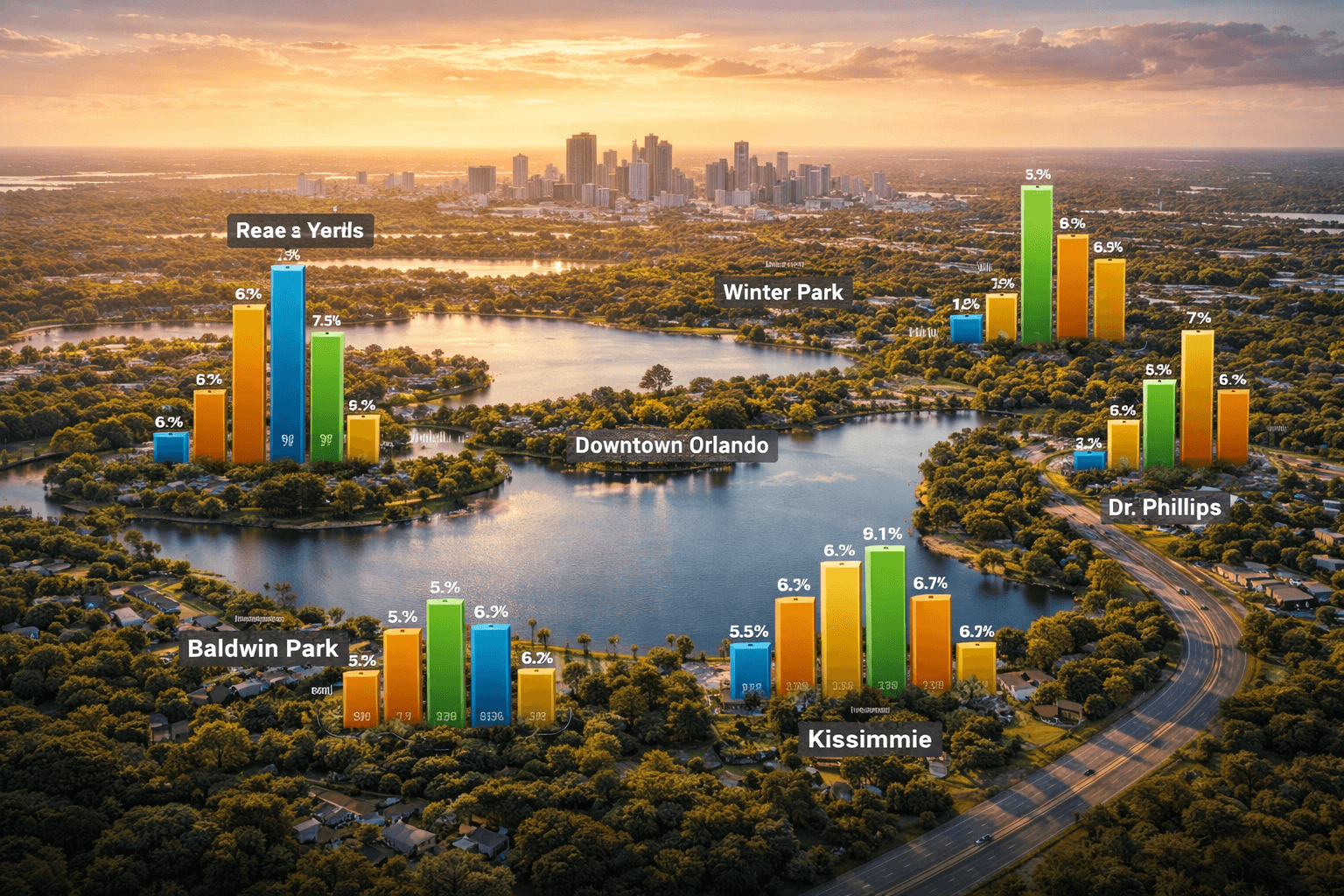
Orlando neighborhood yield map (ZIP-code proxies)
Below are common neighborhood proxies investors reference in and around Orlando. These are not perfect “neighborhood boundaries,” but ZIPs are a practical way to compare like-for-like datasets.
Modeled gross yields (ZIP averages)
| ZIP (Neighborhood proxy) | Zillow avg rent (monthly) | Zillow avg home value (ZHVI) | Modeled gross yield |
| 32822 (Conway / Airport East) | $1,650 | $261,082 | 7.58% |
| 32824 (Meadow Woods / South Orlando) | $2,350 | $396,998 | 7.10% |
| 32837 (Hunters Creek) | $2,289 | $404,424 | 6.79% |
| 32832 (Lake Nona) | $2,800 | $520,995 | 6.45% |
| 32828 (Waterford Lakes / East Orlando) | $2,378 | $461,362 | 6.19% |
| 32806 (SoDo / Delaney Park) | $2,100 | $427,457 | 5.90% |
| 32803 (Colonialtown / Audubon Park area) | $2,150 | $457,383 | 5.64% |
| 32789 (Winter Park core) | $2,500 | $773,445 | 3.88% |
| 32814 (Baldwin Park) | $2,267 | $750,592 | 3.62% |
Orlando city “backdrop” (for orientation)
Using Zillow’s citywide averages: rent ~$1,950 and ZHVI ~$367,868 implies a rough citywide gross yield ~6.36% (screening metric only).
What the numbers are really saying
1) Why higher yields cluster in certain ZIPs
You typically see the highest gross yields where:
- Home values are lower relative to rent levels (price-to-rent is more favorable), or
- Rent demand is steady but price growth has cooled.
In the table, 32822 and 32824 lead on gross yield because the modeled rent-to-value relationship is stronger.
2) Why premium areas often show lower yields
Places like Baldwin Park (32814) and Winter Park core (32789) often have:
- Higher land/value premiums (schools, amenities, prestige, walkability),
- Rent levels that rise too—but not always enough to “keep up” with prices.
That’s why modeled gross yields can look lower there even when long-term desirability is high.
3) Gross yield is not profit
Two ZIPs can have the same gross yield and very different net outcomes because operating costs can vary dramatically—especially in Florida where insurance and HOA can materially change cashflow.
Deeper statistical modeling: stress tests you can copy-paste into underwriting
To move from “yield curiosity” to “yield discipline,” use scenario bands.
Scenario Band A: modest market noise (±5% rent & ±5% value)
A simple way to visualize sensitivity is to compute a downside and upside yield:
- Downside yield: rent –5% AND value +5%
- Upside yield: rent +5% AND value –5%
Examples (selected ZIPs):
- 32822 (Conway / Airport East)
Base 7.58% → Downside ~6.86% → Upside ~8.38% - 32824 (Meadow Woods / South Orlando)
Base 7.10% → Downside ~6.43% → Upside ~7.86% - 32832 (Lake Nona)
Base 6.45% → Downside ~5.84% → Upside ~7.13% - 32814 (Baldwin Park)
Base 3.62% → Downside ~3.28% → Upside ~4.00%
Why this matters: if your deal only works at the upside, it’s not a deal—it’s a bet.
Turning gross yield into a realistic “net yield range”
Because we’re staying educational (not advising, not underwriting your specific property), here’s a framework investors commonly use to translate gross yield into “net reality”:
Step 1: Estimate expense load as a share of rent (rule-of-thumb band)
Many operators model total operating costs (excluding mortgage) as a percentage of collected rent, then refine line-by-line:
- Property taxes
- Insurance
- HOA/COA fees (if applicable)
- Repairs & maintenance
- Capital reserves (roof/HVAC/plumbing)
- Vacancy & turnover
- Property management & leasing
A conservative educational band might be 35%–55% of rent depending on property type, HOA, insurance, age, and tenant profile. (Your actuals can be lower or higher.)
Step 2: Convert gross yield to net yield (conceptual)
If operating costs are, say, 45% of rent, then roughly 55% of gross rent becomes NOI before debt.
So a 7.10% gross yield (like modeled 32824) might translate conceptually into an NOI yield around:
7.10%×0.55≈3.9%7.10\% \times 0.55 \approx 3.9\%7.10%×0.55≈3.9%
That is not a promise or a “typical result”—it’s a demonstration of how expenses compress yield.
Step 3: Compare to broader market benchmarks (context only)
For income-property context, NAR’s commercial insights cited multifamily cap rates ~6.1% in Aug 2025 (commercial multifamily, not SFR).
If your modeled SFR NOI yield after expenses looks far below that, the “return” may depend more on appreciation assumptions than on income strength—a risk you should label explicitly in your analysis.
Orlando-specific context: rent vs. ownership cost pressures (why rent demand can persist)
Orlando QuickFacts shows:
- Median gross rent: $1,747 (2020–2024)
- Median selected monthly owner costs with a mortgage: $2,231 (2020–2024)
This gap helps explain why renters may stay renters longer—supporting rental demand even when home prices soften. Zillow’s current Orlando rent snapshot (~$1,950 average) also aligns with a market where rents remain meaningful relative to buying costs.
Practical “yield drivers” to watch by neighborhood
- A) HOA intensity (especially for planned communities)
- HOA can reduce net yield quickly even if gross yield looks strong.
- Always model HOA as a hard cost, not a footnote (and consider special assessments).
- B) Insurance volatility
Florida’s insurance dynamics can change cashflow more than rent changes. If you want stable net yield, insurance and roof age matter as much as the ZIP code.
- C) Tenant mix and turnover
- Student/young-professional areas can show higher turnover.
- Suburban family rentals can show lower turnover but higher make-ready costs (paint, landscaping, wear-and-tear).
- D) Property type selection within the ZIP
A ZIP-level average includes apartments, condos, townhomes, and single-family rentals. If you’re targeting one product type (e.g., SFR 3/2), you should refine rent comps accordingly.
Compliance, Fair Housing, and “education-only” guardrails
This article is educational and general. It does not provide investment advice, lending advice, or an inducement to buy/sell/rent any specific property.
- Housing decisions and advertising should respect the Fair Housing Act’s equal opportunity principles.
- Real estate markets change; always verify current rent comps, fees, and costs for the specific property.
Bottom line takeaways
- Higher gross yields (modeled) in this ZIP sample cluster in places like 32822, 32824, 32837, where home values are lower relative to rents.
- Premium ZIPs like 32814 (Baldwin Park) and 32789 (Winter Park core) tend to show lower gross yields because price levels are high relative to rents.
- The difference between a “looks-good” yield and a “works” yield is almost always operating costs—especially HOA + insurance in Central Florida.
- If you want a more “investment-grade” view, gross yield is step one; step two is NOI modeling; step three is debt + reserves stress testing.
Author
Asim Iftikhar — Real Estate Contributor, ACT Global Media
Florida Real Estate License: SL3633555
Florida Notary Commission: HH 709161
Asim Iftikhar contributes educational real estate content focused on U.S. residential processes, market structure, and consumer understanding. Content is informational and general in nature.