



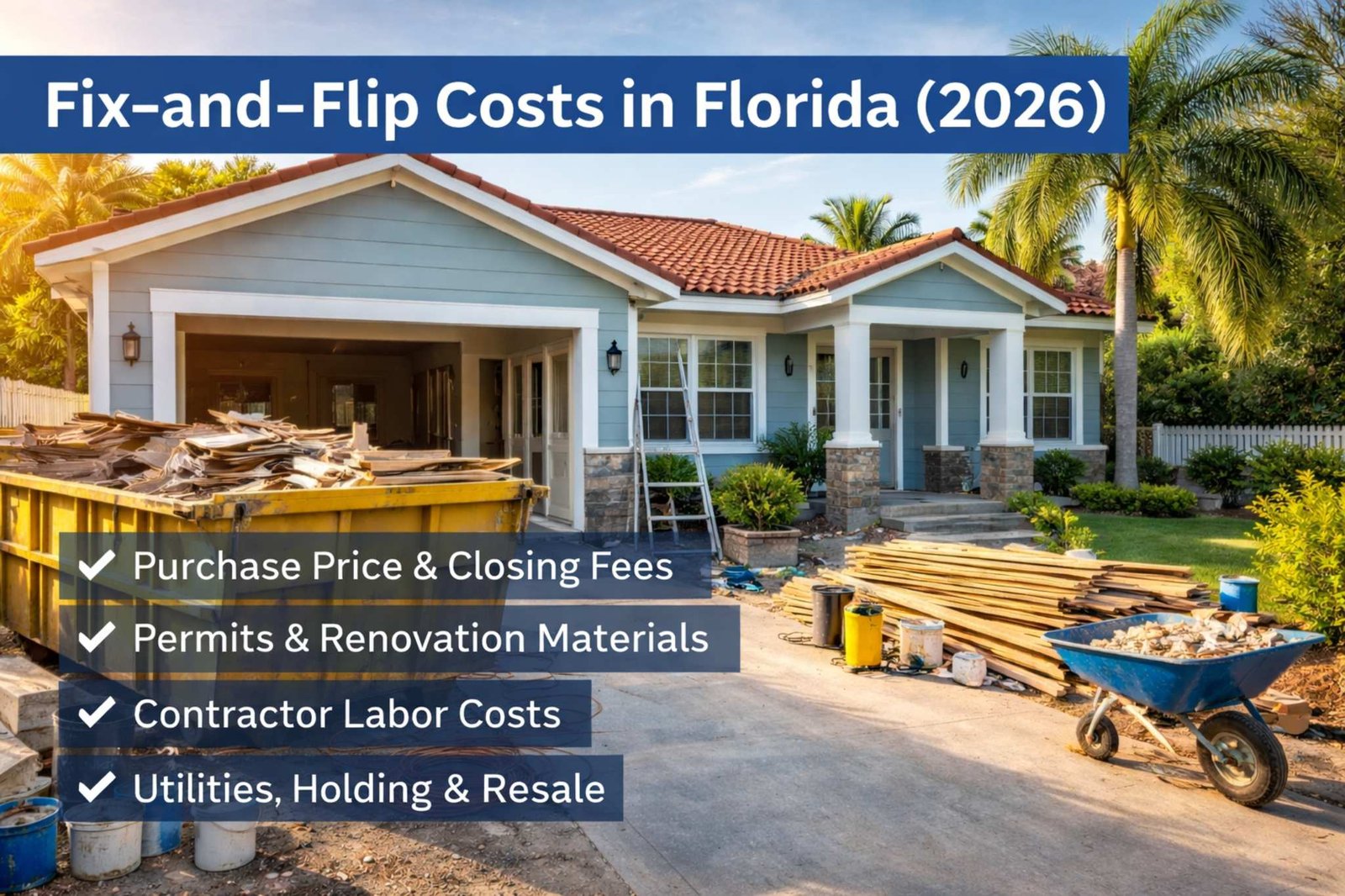
Fix-and-flip investing is often described as “buy low, renovate, sell high.” In real life, the outcome usually depends less on the headline purchase price and more on the total cost stack—the combined costs of acquisition, renovation, carrying/holding, resale, and compliance.
Florida is a unique environment for flips because several line items can be meaningfully different from many other states, including insurance risk, storm hardening expectations, HOA/condo rules, and certain closing-cost taxes and fees. This educational guide breaks down the most common fix-and-flip cost categories in Florida, explains why they vary, and highlights reliable public sources for understanding the biggest variables.
This content is educational only. It does not provide investment, legal, tax, or financial advice, and it does not guarantee outcomes. Costs and timelines vary by property condition, location, contractor availability, permitting, and market conditions.
- The Big Picture: Fix-and-Flip Costs Come in Five Buckets
Most Florida fix-and-flip projects can be summarized into five cost buckets:
- A) Acquisition (buying the property)
B) Renovation and repairs (the rehab scope)
C) Holding costs (while you own the property)
D) Disposition (selling costs)
E) Risk/contingency (unknowns, overruns, and timeline slippage)
A helpful mental model is that “profit” is what remains only after every bucket is fully paid—including taxes, insurance, utilities, permits, and selling costs.
- Florida Acquisition Costs: Purchase Price Is Only the Beginning
Acquisition costs typically include:
- Contract deposit / escrow deposits
• Inspections and due diligence (home inspection, sewer scope where applicable, pool inspection, HVAC, roof, mold, etc.)
• Appraisal (if financing requires it)
• Title/closing fees
• Recording fees and local costs
• Florida documentary stamp taxes (and potentially other state/local taxes depending on structure)
Florida documentary stamp tax on deeds (common Florida-specific cost)
Imposes documentary stamp tax on deeds, generally calculated at $0.70 per $100 (or portion) of consideration in most Florida counties.
Documentary stamp tax on certain obligations (financing documents)
Florida also imposes documentary stamp tax on promissory notes and other written obligations to pay money, often relevant when financing is used and documents are executed.
Florida nonrecurring intangible tax (mortgage-related cost)
Florida has a nonrecurring intangible tax on obligations secured by a mortgage, deed of trust, or similar lien on real property, often encountered in financed transactions.
Educational note: these taxes are typically paid at closing and can materially change your upfront cash requirement. The exact application can vary based on transaction structure and documents used, so buyers commonly confirm charges with their closing agent and qualified advisors.
- Renovation Costs in Florida: The Rehab Budget Is a System, Not a Guess
Rehab costs usually dominate the “variable” side of a flip. Two projects with the same purchase price can diverge widely based on scope, material choices, permitting, and labor availability.
A practical way to organize rehab costs is by categories:
- A) Life-safety and water intrusion first (risk reducers)
Roof repairs/replacement (where needed)
• Plumbing supply and drains (leaks, polybutylene replacement, cast iron issues in older homes)
• Electrical panels, wiring hazards, grounding, code issues
• HVAC replacement/repairs
• Window/door integrity where water intrusion is present
• Structural repairs where required - B) Major systems and functional upgrades
Kitchen and bath remodels (layout, cabinets, counters, plumbing fixtures)
• Flooring throughout
• Interior/exterior paint
• Lighting, fans, switches, trims/doors
• Appliances
• Water heater - C) Exterior and Florida-specific curb appeal items
Landscaping, irrigation repairs
• Driveway/sidewalk repair
• Pool rehab and safety items (if applicable)
• Hurricane/impact considerations (in some scenarios)
• Termite treatment/repairs if needed - D) Permits and code compliance
Permit fees (vary by jurisdiction and scope)
• Engineering (if structural changes)
• Re-inspections and corrections
Why Florida rehab costs can surprise beginners
Florida projects commonly face cost surprises from:
• Water intrusion and hidden mold remediation needs
• Older plumbing and drainage problems
• Roof and wind-mitigation expectations (and insurance impacts)
• Contractor scheduling delays during peak season or after storms
• HOA/condo restrictions that limit scope or require approvals
Using national ROI data carefully (not as a guarantee)
Industry remodeling data is often used as a reference point for the “resale value impact” of renovations. For example, the Cost vs. Value dataset (widely cited in the U.S.) tracks typical cost and value recapture by project type. This kind of data can be useful to understand relative ROI trends (for example, which categories historically recapture more). It is not Florida-specific performance and does not predict results for a specific property.
- Holding Costs in Florida: The Silent Budget Killer
Holding costs are the monthly (and sometimes daily) costs you pay while owning the property during renovation and resale.
Common Florida holding costs include:
- A) Financing costs
Interest payments (hard money/private money, or conventional if applicable)
• Origination/points and lender fees (often upfront)
• Extension fees (if timeline slips)
• Draw fees or inspection fees (if lender controls disbursements) - B) Property taxes
Florida property taxes vary widely by county and can change after a sale due to assessment resets and portability rules. Many investors treat property taxes as a monthly accrual item and verify estimates with county property appraiser records. - C) Insurance (often higher in Florida, sometimes significantly)
Homeowners insurance costs are a major Florida line item and can vary based on roof age, wind mitigation, location, and insurer appetite. The Insurance Information Institute highlights that homeowners insurance premiums and market conditions vary materially by state and risk exposure.
Educational note: fix-and-flip investors often use specialized builder’s risk or vacant property coverage rather than standard owner-occupied policies, depending on the property and insurer. - D) Utilities and property maintenance
Electric, water, sewer, trash
• Lawn maintenance
• Pool maintenance
• Pest control
• Security monitoring (if used)
Vacant properties can require additional preventative maintenance to reduce risk. - E) HOA/condo dues (if applicable)
In condo and HOA communities, monthly dues can materially change holding costs, and there can be special assessments or approval timelines that affect renovation schedules.
- Disposition Costs: What It Costs to Sell in Florida
Disposition costs are the costs to sell the property after renovation. These often include:
- Agent commissions (if using agents)
• Seller concessions (varies by market conditions)
• Title fees / settlement fees for the sale closing
• Documentary stamp tax on the deed (seller-side in many Florida resale transactions)
• Repairs requested after inspection
• Staging (optional)
• Professional photography / marketing (optional, but common)
Even if the market is strong, selling typically has meaningful friction costs, and those costs can grow if the property sits longer than expected.
- Florida “Hidden Costs” That Commonly Affect Flips
These line items are frequently underestimated by newer investors:
- A) Permitting delays and rework
A permit itself may be a smaller cost than the time impact. Extended timelines increase financing and utility costs. They can also push the sale into a slower season. - B) Change orders and scope creep
Once walls open, projects can expand. A conservative approach is to plan a contingency reserve for unknowns, especially for older homes. - C) Insurance-driven requirements
In Florida, roof condition and wind-related factors can affect insurability and premiums. If the end buyer struggles to insure the property affordably, that can reduce buyer pool. - D) Vacancy and vandalism risk
Vacant properties may face higher risk of theft or damage. Prevention has a cost (security, lighting, cameras, regular visits). - E) Post-renovation “quality control” fixes
Small punch-list items, touch-up paint, trim repairs, and final cleaning can add up. They also matter because they affect inspection outcomes and buyer confidence.
- Market Reality: What National Flip Data Suggests About Margins
Many investors look to national flip performance reports to understand broad market conditions. ATTOM’s U.S. Home Flipping Reports (national data) are commonly referenced for gross profits and ROI trends, though results vary significantly by metro and property type.
Educational note: national averages are not a business plan. Florida submarkets can behave very differently from national medians. Use national data as context only. - A Practical Cost Framework (Educational Template)
Below is an educational framework many investors use to organize costs. It is not a recommendation and does not include every scenario.
- A) Upfront (acquisition)
Earnest money deposit
• Inspection bundle (home, roof, HVAC, pool, sewer scope where relevant)
• Appraisal (if required)
• Closing fees (title/settlement/recording)
• Florida documentary stamp taxes (as applicable)
• Financing fees/points (if applicable) - B) Rehab (renovation)
Demo + dumpsters
• Rough trade repairs (plumbing/electrical/HVAC)
• Drywall, texture, paint
• Flooring
• Cabinets/counters
• Fixtures (plumbing/lighting)
• Appliances
• Exterior repairs, landscaping
• Permits/inspections
• Final cleaning and punch list - C) Monthly holding (multiply by your timeline)
Loan interest
• Taxes accrual
• Insurance
• Utilities
• Maintenance/HOA dues - D) Sale (disposition)
Commission
• Closing costs
• Documentary stamp tax on deed (commonly in Florida)
• Concessions and repair credits
• Staging/marketing (optional) - E) Reserve (risk buffer)
Contingency reserve for overrun and delays
Because timeline risk often drives cost overruns, many investors treat contingency as both “extra money” and “extra time.”
- Tax and Reporting Considerations Fix-and-flip income and expenses can raise tax considerations. The treatment depends on facts and circumstances (for example, whether a taxpayer is treated as an investor vs. a dealer, how long the property is held, and how activities are structured).
The IRS provides general guidance on basis and improvements (what costs add to basis), which can matter when calculating gain.
Because tax outcomes vary by situation, many investors consult qualified tax professionals for proper reporting and compliance.
- The Florida Takeaway: Cost Control Is a Strategy
In Florida, some of the most “make-or-break” factors are not glamorous:
- Insurance and risk mitigation
• Timeline discipline (because carrying costs compound quickly)
• Permit and HOA processes
• Rehab scope control (avoiding over-improvement relative to the neighborhood)
• Accurate accounting for transaction taxes and closing costs
A flip can look profitable on a quick estimate and still underperform once taxes, insurance, permits, and delays are included. That is why experienced operators focus on a cost system—not just a rehab checklist.
Author Credit
Asim Iftikhar — Real Estate Contributor, ACT Global Media
Florida Real Estate Sales Associate License: SL3633555
Florida Notary Public Commission: HH 709161
Editorial Disclosure
This article is provided for general informational purposes only and does not constitute real estate, investment, mortgage, insurance, tax, legal, or financial advice. Examples are illustrative, not guarantees. Costs, taxes, insurance availability, and market conditions vary by property, location, timing, and individual circumstances. Readers should consult qualified professionals for guidance specific to their situation.