




Household formation alone doesn’t tell the full story of the housing market. Whether new households begin as renters or homeowners plays an equally important role in shaping demand, inventory, and long-term market dynamics.
WEBDESK | ACT GLOBAL MEDIA | JANUARY 20, 2026
Household Growth Skewed Toward Homeownership in 2024
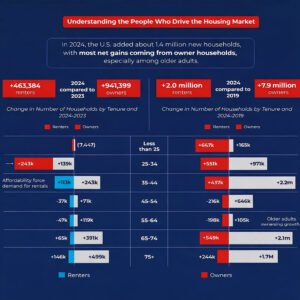
In 2024, the United States recorded the formation of roughly 1.4 million new households compared to the previous year. This growth, however, was not evenly distributed. A significantly larger share of new households entered the market as homeowners, while a smaller—but still meaningful—portion began as renters. As a result, net household growth last year leaned more heavily toward ownership than rental housing.
Older Americans Are Driving Owner Household Growth
Age is a key factor behind this pattern. Most of the increase in homeowner households came from older age groups, particularly those 65 and above. Longer life expectancy, a rise in aging-in-place, and homeowners choosing to remain in their properties longer have all contributed to this trend.
Importantly, these households are not always active buyers. Instead, their decisions influence the market indirectly—by slowing housing turnover, limiting available inventory, and reshaping supply conditions across many regions.
Younger Households Continue to Enter as Renters
In contrast, younger households are far more likely to begin their housing journey in rental properties. Affordability challenges, higher home prices, and financing constraints mean that many new households are forming without immediate access to homeownership. This dynamic helps explain why rental demand remains strong, even during periods when overall household growth appears modest.
Five-Year Trends Confirm the Demographic Divide
A longer-term perspective reinforces these findings. Since 2019, renter household growth has been concentrated largely among younger age groups, while the expansion of owner households has been driven overwhelmingly by older Americans. Households aged 65–74 and 75+ account for a substantial share of the net increase in homeownership over the past five years.
This demographic shift sheds light on why housing inventory has been slow to recover and why market conditions vary so widely across regions.
What This Means for the Housing Market
For housing professionals and market observers, these trends provide important context. They explain persistent tightness in rental markets, the gradual pace at which first-time buyers are entering homeownership, and the supply constraints that continue to shape many local markets.
Housing demand today is not dominated by a single generation. Instead, it reflects younger households forming under affordability pressure and older households redefining how long they stay in their homes. Understanding who is forming households, how they enter the market, and how demographics shape housing decisions is essential to navigating today’s housing landscape—and anticipating what comes next.